Smart Sourcing: Environmentally Friendly Promotional Items
Most advice on environmentally friendly promotional items starts in the wrong place. It starts with the material. Recycled this. Bamboo that. Organic cotton everything.
That's how brands end up buying merch that looks responsible on a product page and behaves like disposable junk in real life.
A tote made from recycled inputs isn't automatically a good decision. Neither is a “sustainable” tee with a vague hangtag claim and no proof behind it. If the item is cheap, forgettable, hard to verify, or destined for the trash after one event, the eco label doesn't save it. It just makes the waste easier to justify.
The better approach is less flattering and more useful. Treat environmentally friendly promotional items as a full-lifecycle sourcing problem. Ask for proof. Prioritize durability. Think about end-of-life before production starts. Build specs like a procurement team, not a Pinterest board.
Table of Contents
Why Most Eco-Friendly Merch Is a Waste of Money
The biggest myth in branded merch is that an eco material automatically makes the item sustainable. It doesn't. It just means one input may be better than the default.
That distinction matters because brands are spending real money in this category. The US eco-friendly promotional product segment was cited at $2.9 billion, representing 14.2% of the total $20.4 billion industry, and that eco segment was said to be growing at 14.5% per year in Pavilion Earth's roundup citing The Business Desk and NPD data. A lot of that spend still goes into products that feel good at approval stage and underperform once they hit people's hands.
Cheap eco merch is still cheap merch
A recycled bottle turned into a tote bag doesn't fix bad product judgment. If the stitching is weak, the shape is awkward, or the print cracks after a few uses, nobody cares what story was attached to the material.
The same goes for branded apparel. A thin “organic” tee with a boxy fit and rough hand feel still gets demoted to pajama status, then forgotten. That's not sustainability. That's waste with nicer copy.
Practical rule: If the item isn't good enough to compete with what people already own, don't produce it.
The harsh truth is that most merch fails because teams buy for distribution, not retention. They optimize for unit cost, event volume, and lead-gen theater. Then they act surprised when the result feels disposable.
Sustainability starts with relevance
Useful merch survives. Irrelevant merch doesn't.
That sounds obvious, but most briefs ignore it. Teams ask for “eco-friendly promotional items” without defining who will use them, where they'll use them, and whether the item fits the recipient's life. A commuter cup, heavyweight hoodie, or clean everyday tote can make sense. A random desk trinket with a recycled claim usually doesn't.
A better benchmark is simple. Buy fewer things. Make them better. Make them desirable enough to stay in rotation. That's also why smart teams increasingly favor practical onboarding and culture pieces over generic giveaway piles. If you're building kits for new hires, welcome gifts for new employees work better when every item has a clear reason to exist.
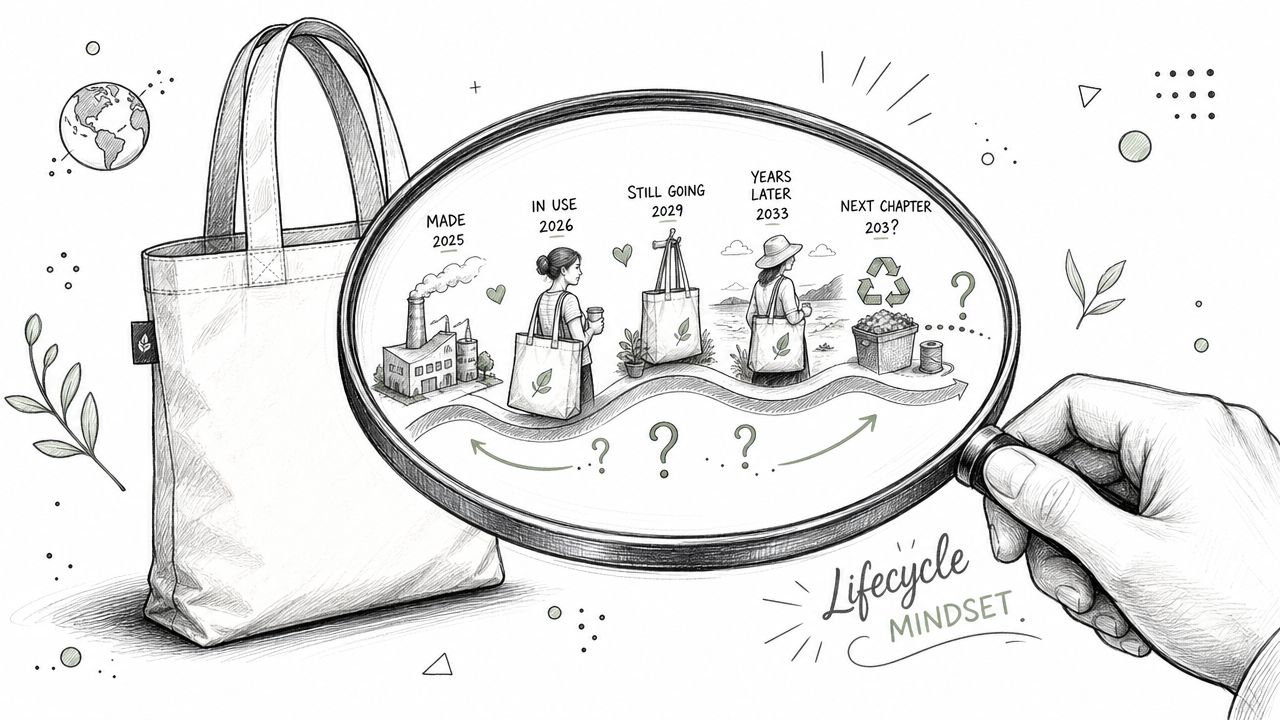
Adopt a Lifecycle Mindset Before You Buy
Most buyers stop at sourcing. Serious buyers think all the way through use, wear, storage, disposal, and replacement.
That's the shift. Don't ask only, “Is this recycled?” Ask, “Will this still be in someone's daily life a year from now?” Then keep going. Ask what happens when it wears out, whether the recipient will know how to dispose of it, and whether the branding makes it more likely to be kept or tossed.
A useful reality check comes from end-of-life data. Only about 32.1% of municipal solid waste in the U.S. was recycled or composted in 2018, according to the EPA figure cited in this ChicoBag article on eco-conscious promotional items. That's why “recyclable” is a weak comfort blanket. A branded item can be technically recyclable and still end up discarded.
Stop buying for the campaign and start buying for the afterlife
A lot of environmentally friendly promotional items are selected for the moment they're handed out. That's backward. The handoff is the shortest part of the product's life.
Think about the item in five stages:
Selection
Choose products with a clear use case. Not vague usefulness. Real usefulness. Office commute, gym, travel, remote work, conferences, daily carry.Design
Keep branding restrained enough that people will use it outside the event. Loud campaign graphics can tank long-term wear.Build quality
Durability is not a nice-to-have. Fabric weight, seam construction, closure quality, print method, and wash performance decide whether the item survives.Care and reuse
If it's annoying to clean, awkward to store, or fragile in normal use, people stop reaching for it.End-of-life
If the material mix makes disposal confusing, or the product degrades fast, your “sustainable” choice collapses at the finish line.
Most merch briefs are built around ordering. Better merch briefs are built around years of use.
A reusable item only becomes a better choice if people reuse it. That's why something straightforward like a well-made recycled cup for daily use can outperform a more “interesting” product with weaker utility.
Use beats material claims
In this context, teams overcomplicate things. They compare buzzwords and ignore behavior.
A premium item with clean design, good construction, and obvious utility usually does more good than a flimsy product with a trendy material story. Heavyweight hoodies, durable totes, quality drinkware, and notebooks that feel good to carry all have one thing in common. People keep them when they fit into real routines.
A quick decision filter helps:
| Question | Good sign | Bad sign |
|---|---|---|
| Will people use it weekly? | Fits a real habit | Feels event-specific |
| Does it age well? | Durable materials and timeless styling | Thin, gimmicky, trend-chasing |
| Is disposal obvious? | Clear material and end-of-life info | Mixed materials and vague claims |
| Would someone choose it without the logo? | Yes | No |
If the item fails that table, the sourcing conversation is already off track.
Decoding Sustainable Materials and Certifications
Material talk gets messy because brands confuse a category label with actual verification. “Organic,” “recycled,” and “eco-friendly” sound clear until you ask for documentation.
That's the line buyers need to hold. A sustainability claim without traceability is just packaging.
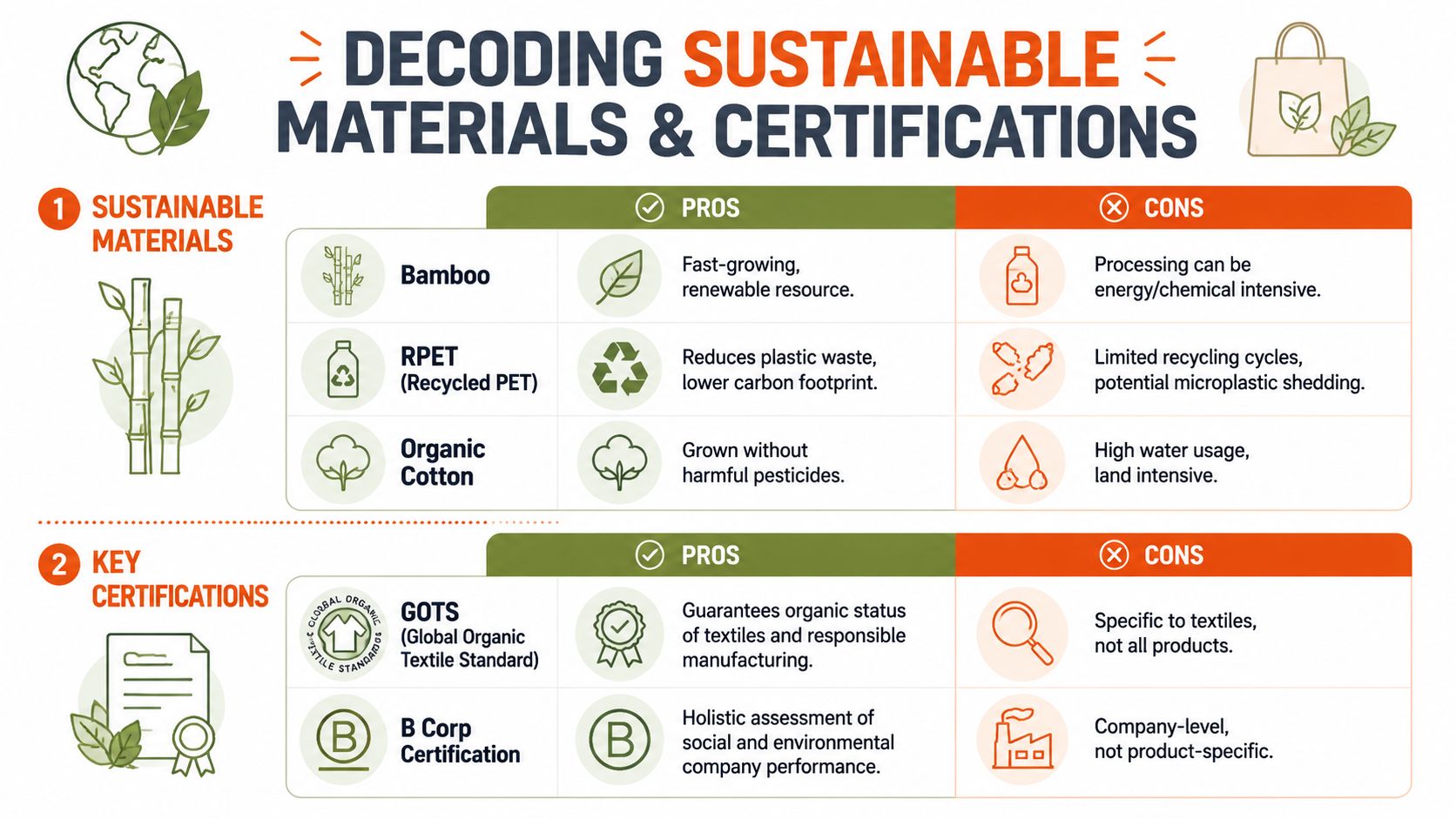
One practical sourcing guide gets this right. It recommends requiring specific certifications and traceable claims, including OEKO-TEX STANDARD 100 certification with certificate number, using specific claims such as GOTS or GRS, and running a 50–100 person pilot with 90-day tracking of satisfaction, usage, and durability before scaling. It also flags vague sustainability language as the main technical pitfall and recommends documenting material composition, certifications, and item-level environmental benefits for every SKU in Hurrdat Brand Goods' guide to sustainable promotional apparel.
The claim is not the proof
Some material choices can make sense. The mistake is treating them as interchangeable badges of virtue.
- Organic cotton can be a strong option for apparel and totes, but “organic” on its own is weaker than a clear textile certification.
- Recycled polyester or RPET can be useful, especially where performance matters, but the claim should be tied to an actual standard rather than a casual product blurb.
- Bamboo gets overmarketed. Fast-growing input does not automatically mean low-impact finished product.
If there's one sourcing habit worth stealing from better procurement teams, it's this: stop asking what the item is called and start asking what can be verified.
What to ask for on the spec sheet
Buyers don't need a chemistry degree. They need a clean documentation standard.
Ask for these details before approving production:
- Material composition: Exact fiber or material breakdown for the finished item.
- Certification detail: Certification name plus certificate number where relevant.
- Decoration method: Screen print, embroidery, engraving, transfer, or another method that affects durability and feel.
- Country and factory context: Enough transparency to understand where customization or assembly happens.
- Item-level note: A plain-language explanation of the claimed environmental benefit.
If a supplier can't move past words like “green,” “responsible,” or “planet-friendly,” they haven't done the hard part.
For apparel, this gets even more important because fit and fabric quality decide whether people keep the piece. That's why teams sourcing hoodies should care about more than fabric labels. A guide to the best hoodie blanks is useful here because blank quality often predicts whether the garment earns repeat wear.
How to Vet Suppliers and Spot Greenwashing
A polished catalog can hide a lot. Nice mockups, soft-focus sustainability language, and a few leaf icons don't tell you much about how a supplier operates.
The scrutiny is justified. FTC guidance pushes brands toward specific and substantiated environmental claims, and the EU has also been advancing tighter scrutiny. At the same time, only 23% of major fashion companies disclosed information about their traceability policies in the Fashion Revolution Fashion Transparency Index 2024, as cited in this Successories article on eco-friendly materials. If traceability is still limited in adjacent apparel supply chains, merch buyers shouldn't assume promo vendors have it magically sorted.
A simple checklist helps cut through the performance.
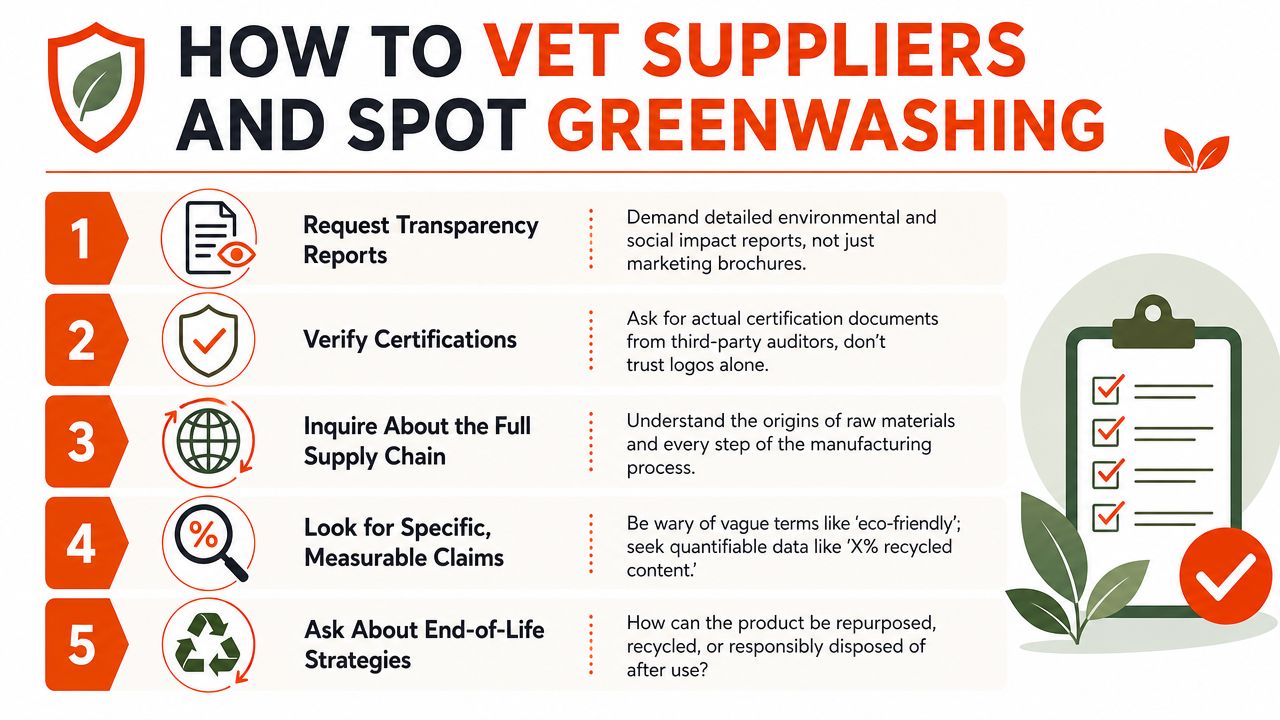
The red flags show up fast
You can usually spot greenwashing in the first conversation.
- Vague language first: The supplier leads with “eco-conscious” and “sustainable solutions” instead of product specs.
- Logos without proof: They show badges but won't provide certification details.
- No item-level clarity: They can talk about the company mission, but not about the actual SKU you're buying.
- Overpromising: Every product is framed as the perfect sustainable choice. Real suppliers talk in trade-offs.
- Deflection on durability: When asked how the item holds up, they pivot back to materials.
This short video is a good reminder that surface-level claims are easy to produce and hard to trust without process:
Questions worth asking before you approve anything
Don't ask whether a supplier offers environmentally friendly promotional items. Of course they'll say yes. Ask questions that force specifics.
Try this list instead:
Can you provide the exact certification reference for this product?
Not the logo. The document trail.What is the material composition of the finished item, including trims and lining if relevant?
Mixed-material products often get sold with one clean front-end claim.How is the decoration applied, and what usually happens to it after repeat use or washing?
Sustainability dies quickly when the print peels and the item gets tossed.What should the end user do with this item at end-of-life?
If the answer is fuzzy, the claim probably is too.What proof do you provide before bulk production?
Sample photos, pre-production approvals, physical samples, and print tests matter.
For branded apparel, printing choices can subtly ruin a good blank. Teams comparing vendors should understand custom shirt printing methods because decoration quality affects longevity as much as the fabric does.
Buyers should reward suppliers who answer uncomfortable questions cleanly. That's usually where the real operators separate themselves from the brochure merchants.
Building Your Spec Sheet A Real-World Example
Most sustainability problems in merch start before production. They start in the brief.
If the request is vague, the result will be vague too. And vague merch is where quality slips, substitutions happen, and “eco-friendly” turns into a catch-all excuse for whatever was easiest to source.
A visual reference helps anchor the level of detail serious teams should expect:
A bad brief
Here's the kind of request that creates problems:
Need 100 eco-friendly tote bags with our logo for an event next month.
That sounds fine until you realize it says almost nothing. No fabric weight. No certification requirement. No handle length. No color standard. No print method. No packaging guidance. No proof standard. No durability expectation.
A supplier now has too much room to interpret. That usually means they'll optimize for convenience, not for quality or long-term use.
A professional brief
A stronger brief is specific enough that two different suppliers would quote roughly the same thing.
| Spec area | Weak version | Strong version |
|---|---|---|
| Product | Tote bag | Heavyweight tote bag |
| Material | Eco-friendly fabric | 100% certified material with documented composition |
| Build | Standard | Structured body, reinforced handles |
| Decoration | Logo print | One-side screen print with approved color reference |
| Proof | Mockup | Pre-production proof and sample approval |
| Packaging | Default | Minimal recyclable packaging, no unnecessary inserts |
| End-of-life | Not mentioned | Disposal guidance required if material mix needs it |
Here's what a workable merch brief sounds like in plain English:
- Product choice: Heavyweight everyday tote, not a thin giveaway bag.
- Material requirement: Certified textile claim with supporting documentation.
- Construction detail: Reinforced stitching and dimensions that fit actual daily carry.
- Branding approach: Clean one-side artwork, sized for real-world wearability instead of maximum logo exposure.
- Production control: Sample approval before bulk run.
- Packaging note: Keep it minimal and recyclable.
- Recipient logic: Intended for repeat use, not one-day event traffic.
That level of detail protects quality and cuts waste because it reduces surprise substitutions and bad-fit outcomes. It also forces the team ordering the product to clarify what they want.
Better merch comes from better constraints. The spec sheet is where sustainability stops being a vibe and becomes a purchasing standard.
Finishing the Job Packaging and Fulfillment
A decent product can still be undermined by lazy packaging and sloppy logistics. Teams obsess over the item and then ship it in a way that adds unnecessary waste, damages the experience, or creates avoidable friction for the recipient.
Packaging should do one job well. Protect the item, communicate the brand cleanly, and avoid excess. That usually means recycled or recyclable packaging materials, fewer layers, and no random filler that exists only to simulate premium value. Premium doesn't have to mean overbuilt.
Packaging can undo a good product decision
The common mistake is trying to make packaging feel expensive by adding more components. Extra sleeves, oversized boxes, glossy inserts, and novelty add-ons often have weak functional value.
A better standard looks like this:
- Right-sized packaging: Don't ship a cap in a box built for a hoodie.
- Material restraint: Use packaging that's easy to recycle in the recipient's market.
- Useful inserts only: If you include a card, make it count. Care instructions or disposal guidance is more useful than generic brand copy.
Fulfillment is part of the product experience
Fulfillment also shapes whether the program feels thoughtful or wasteful. Distributed teams, creator campaigns, and event follow-ups often need inventory storage, kitting, and shipping to multiple recipients. If that process is chaotic, products get overpacked, mis-shipped, or duplicated.
Good fulfillment planning keeps the product intact and the operation sane. For teams comparing partners, a guide to merch fulfillment services is worth reviewing because storage, kitting, and multi-address shipping aren't side details. They're part of the system.
The cleanest environmentally friendly promotional items strategy is the one that holds together from first spec to final delivery. Good product. Verified claims. Durable build. Minimal packaging. Competent fulfillment. Miss one of those and the rest starts to wobble.
If your team wants to build merch people keep, Banger is built for that. Premium blanks, custom branded apparel, French ateliers, low minimums, and worldwide fulfillment. Request a quote, get product previews within 24h, and launch merch that feels intentional instead of disposable.