Build Your Startup Clothing Line: Expert Guide 2026
Most advice about starting a clothing line is built around the cheapest possible path to launch. Print-on-demand. Generic blanks. Fast mockups. Minimal risk. That advice is fine if your goal is to put a logo on a hoodie and see what happens.
It's weak advice if you want to build a startup clothing line people care about.
A real apparel line isn't just inventory. It's identity in physical form. It tells your team, your customers, and your community what kind of brand you are when nobody is reading your homepage. In a crowded category, that difference matters more than almost anything else.
Table of Contents
Beyond Merch Building a Cultural Asset
The apparel category is massive, but that doesn't make it easy. The global apparel market was valued at $1.84 trillion in 2025, yet 90% of clothing startups fail, and 79% of fashion sales still happen in stores, which means an online-first founder has to sell more than convenience. They have to sell identity and quality (global apparel market and startup survival data).
That's why the usual “just launch a tee” advice misses the point. Cheap merch can get produced quickly. It rarely becomes part of someone's wardrobe. If the garment feels disposable, the brand attached to it feels disposable too.
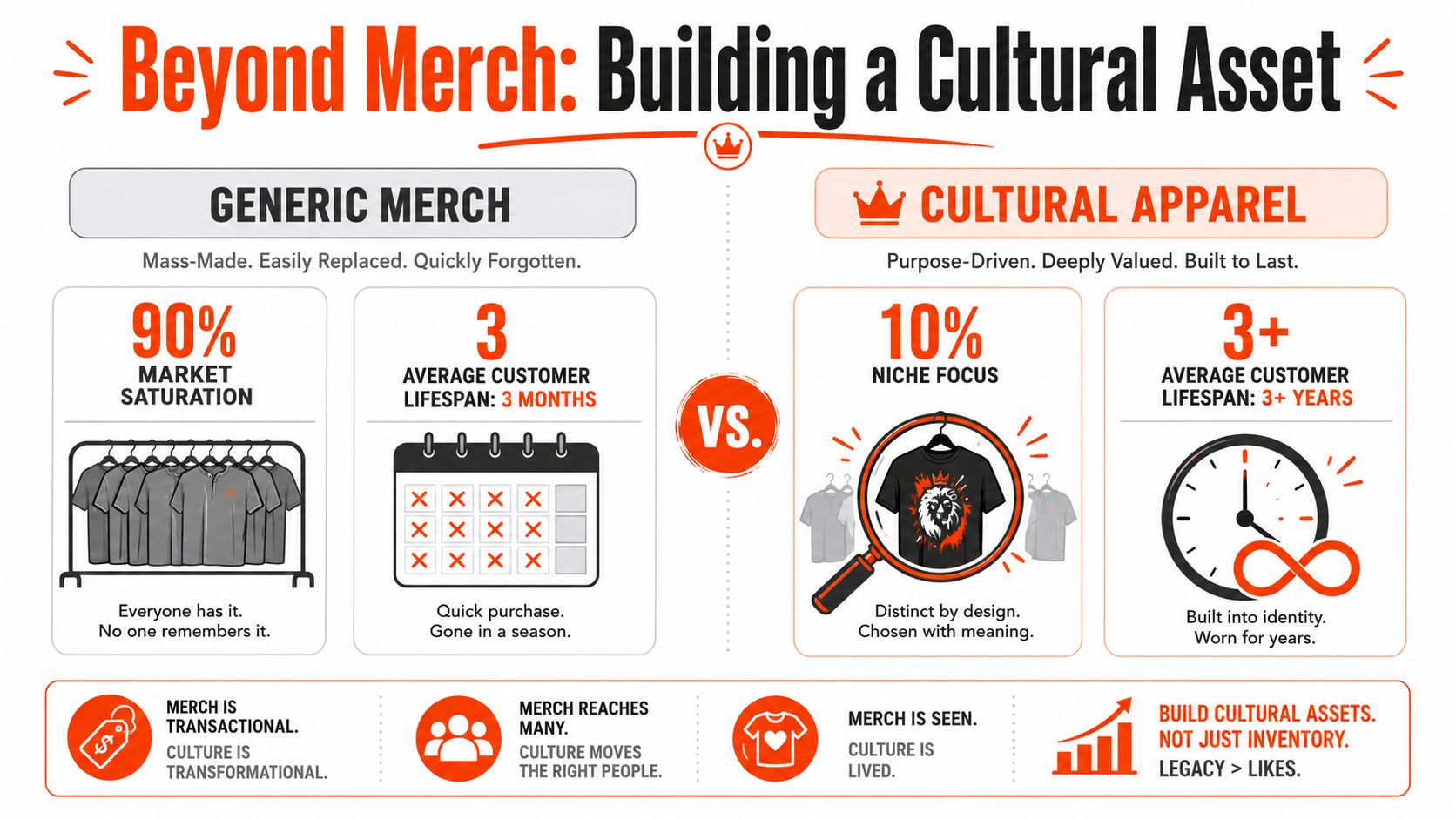
Why generic merch fails
Founders often treat apparel like a marketing add-on. That creates predictable bad decisions:
- They optimize for unit cost first. The result is thin fabric, weak fit, and decoration that looks dated fast.
- They design around the logo. People don't wear logos by default. They wear silhouettes, textures, colors, and pieces that fit their identity.
- They skip product discipline. No wash testing. No sizing logic. No thought for packaging, reorder flow, or consistency.
A startup clothing line can't survive on novelty alone. It needs repeat wear.
Generic merch asks for attention once. Good apparel earns it over and over.
What a cultural asset looks like
A cultural asset does three things at once. It functions as product, signal, and memory. Someone wears the hoodie because it feels good. They keep wearing it because it says something about them. They remember the brand because the object held up.
That's the standard modern teams should be building toward, whether the line is customer-facing or internal. Even something as straightforward as welcome gifts for new employees works better when the apparel feels like a piece worth keeping, not an HR leftover.
For internet-native brands, culture is rarely built through one giant campaign. It's built through repeated objects and moments. A heavyweight crewneck your team reaches for on weekends does more for brand perception than a pile of giveaway tees no one wants after the event.
The failure rate in apparel isn't just a warning. It's a filter. It removes the founders who think product quality is optional.
The Blueprint Defining Your Brand and Budget
Founders waste months on references that never had a chance of becoming a real line. A moodboard can sharpen taste. It cannot define product, margin, customer, or why anyone should come back for the second drop.
Strong startup clothing lines begin with a point of view you can turn into repeatable product. Sometimes that starts with a frustration in the market. Sometimes it starts with a specific wearer and a gap no one is serving well. Either way, the brief has to be concrete enough that a factory, a customer, and your own team would all describe the brand the same way.
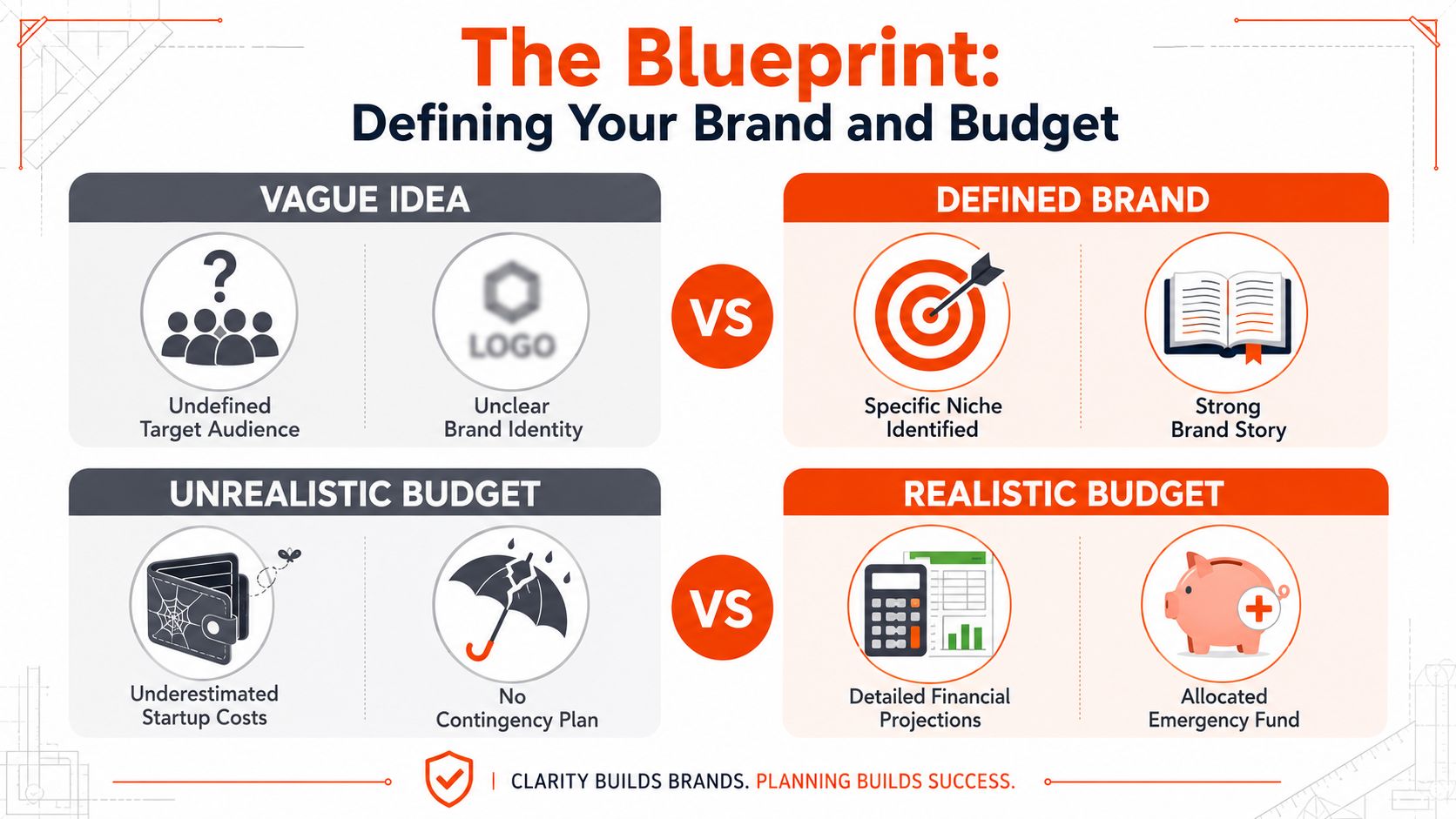
Start with a problem not a moodboard
The cleanest early concepts usually solve something specific. GeekWire covered a women's workwear startup built around fixing the lack of usable pockets in professional clothing, which gave the brand a clear product argument from day one (women's workwear example from GeekWire).
That standard applies to streetwear and premium basics too. “Better quality” is too vague. “Cropped hoodie with real structure, dense cuffs, and a hood that holds shape after wash” is a product direction. “Graphic tees for creatives” is too broad. “Boxy heavyweight tee with washed surface, restrained front hit, and oversized back placement tied to a tight cultural reference” is something a customer can choose on purpose.
Use these questions to pressure-test the idea:
- What is the buyer currently settling for? Bad fit, weak collar, thin fleece, poor wash recovery, cheap drawcords, bad proportions.
- What would make them switch fast? Better silhouette, better fabric, better finishing, or a clearer identity in how the piece wears.
- Can you repeat that advantage across multiple drops? If yes, you have the start of a brand system.
Graphic direction matters, but only after the product logic is clear. If you are evaluating decoration methods, study custom shirt printing options for brand-led apparel based on durability, hand feel, and visual character, not just speed or unit cost.
Practical rule: If the product loses all appeal once the logo disappears, the line is still too thin.
Match your budget to your promise
Budget decides what kind of brand you are able to build in year one. It affects silhouette control, fabric access, trim choices, sampling speed, inventory risk, and how much inconsistency the customer will tolerate before they stop trusting you.
Founders aiming for a premium position often make the same mistake. They promise custom-level quality, then budget for off-the-shelf blanks and surface decoration. That can work for testing demand. It does not hold up if your brand claim depends on fit, weight, finish, and feel.
Here is the trade-off:
| Model | What it's good for | What it limits |
|---|---|---|
| Print on demand | Quick market testing, low upfront risk | Limited control over fabric, fit, finishing, and brand cues |
| Hybrid small-batch | Better control with lower inventory exposure | More vendor management, more sampling decisions, tighter cash discipline |
| Full custom manufacturing | Signature fit, stronger quality control, better long-term brand equity | Higher development cost, slower timelines, larger mistakes if you guess wrong |
For a culture-driven startup clothing line, the sweet spot is often a narrow small-batch approach. One hero tee. One fleece style. One cap or accessory if it is integral to the world of the brand. Low MOQ production can work, but only if you are selective about where to spend. Fabric and fit usually deserve the money first. Fancy packaging can wait. Extra colorways can wait. Five weak SKUs do less for your reputation than one piece people keep reaching for.
Keep the promise tight. Then fund that promise with integrity. Customers will forgive a small opening assortment. They will not forgive a brand that talks premium and delivers promotional-grade product.
Product Sourcing and Tech Pack Essentials
The idealized vision for your startup clothing line often encounters friction. Fabric lead times. Minimums. Inconsistent sizing. Decoration limitations. Sampling rounds that reveal your “perfect” design doesn't wear well.
The founders who handle this stage well stop talking like marketers and start talking like product people.
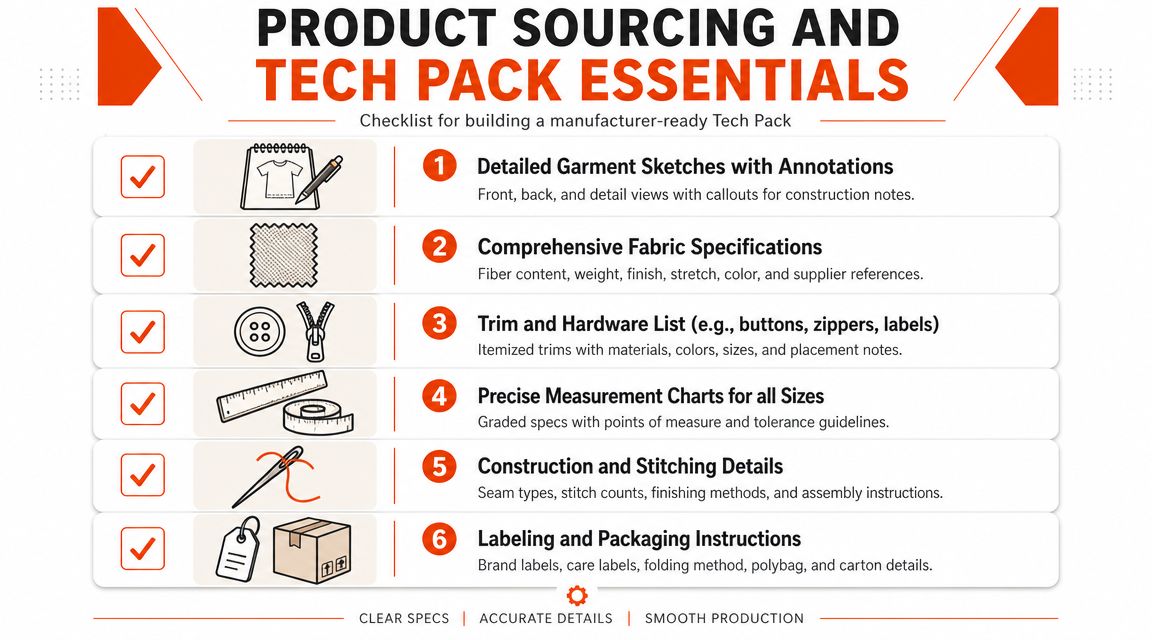
What belongs in a real tech pack
A tech pack is the manufacturing brief that keeps your idea from getting interpreted into something cheaper, looser, or less refined than you intended.
At minimum, it should include:
- Garment sketches. Front, back, and detail views with callouts.
- Fabric specs. Weight, composition, finish, and feel expectations.
- Measurement chart. Base size plus grading direction across sizes.
- Construction notes. Stitch types, seam finishing, rib specs, placket details, pocket dimensions.
- Trim list. Labels, drawcords, zippers, snaps, eyelets, patches, hang tags.
- Artwork placement. Exact dimensions and positions for print or embroidery.
- Packaging instructions. Fold method, polybag or no polybag, insert cards, sticker placement.
Missing details don't create flexibility. They create factory guesswork.
Here's a useful walkthrough of how production thinking shows up in practice:
Premium blanks or cut and sew
This decision shapes almost everything after it.
Premium blanks make sense when you want speed, lower development friction, and a cleaner first launch. They work especially well for heavyweight tees, hoodies, sweatshirts, caps, and other categories where the base silhouette is already strong.
Cut and sew makes sense when your brand needs proprietary fit, custom paneling, unusual materials, or signature construction details that blanks can't deliver.
The trap is choosing cut and sew too early for the wrong reasons. Founders often overestimate how much custom pattern work matters before they've proven demand. If your audience is responding to weight, wash, fit balance, and finishing, a premium blank plus the right trims can get you very far.
The bigger operational question is how to stay premium without getting buried in inventory. Modern micro-factory and low-MOQ models can help reduce dead stock and lead times, but only if the partner can still protect quality and margin on small runs (low-MOQ and micro-factory production guidance).
How to vet a production partner
Don't just ask for pricing. Ask how they think.
Use a short filter:
- Request samples first. You're checking hand feel, stitching consistency, print clarity, and how the garment behaves after washing.
- Ask how reorders work. A good first run matters. A repeatable second run matters more.
- Check finishing options. Neck labels, hang tags, custom packaging, fold standards.
- Probe communication quality. Slow, vague replies usually become expensive later.
If you need a partner that can handle low-minimum product development and custom product sourcing, make sure they can talk through blanks, custom trims, and fulfillment constraints in one conversation. That usually tells you whether they understand real apparel operations or just order processing.
Manufacturing and Premium Customization Techniques
Manufacturing choices decide whether your first drop reads like a real brand or leftover company merch with better graphics. Founders usually lose that battle in the finishing. The base garment is solid, then the print cracks too fast, the embroidery sits stiff, or the trim package feels generic.
Decoration is part of product design, not a final production checkbox.
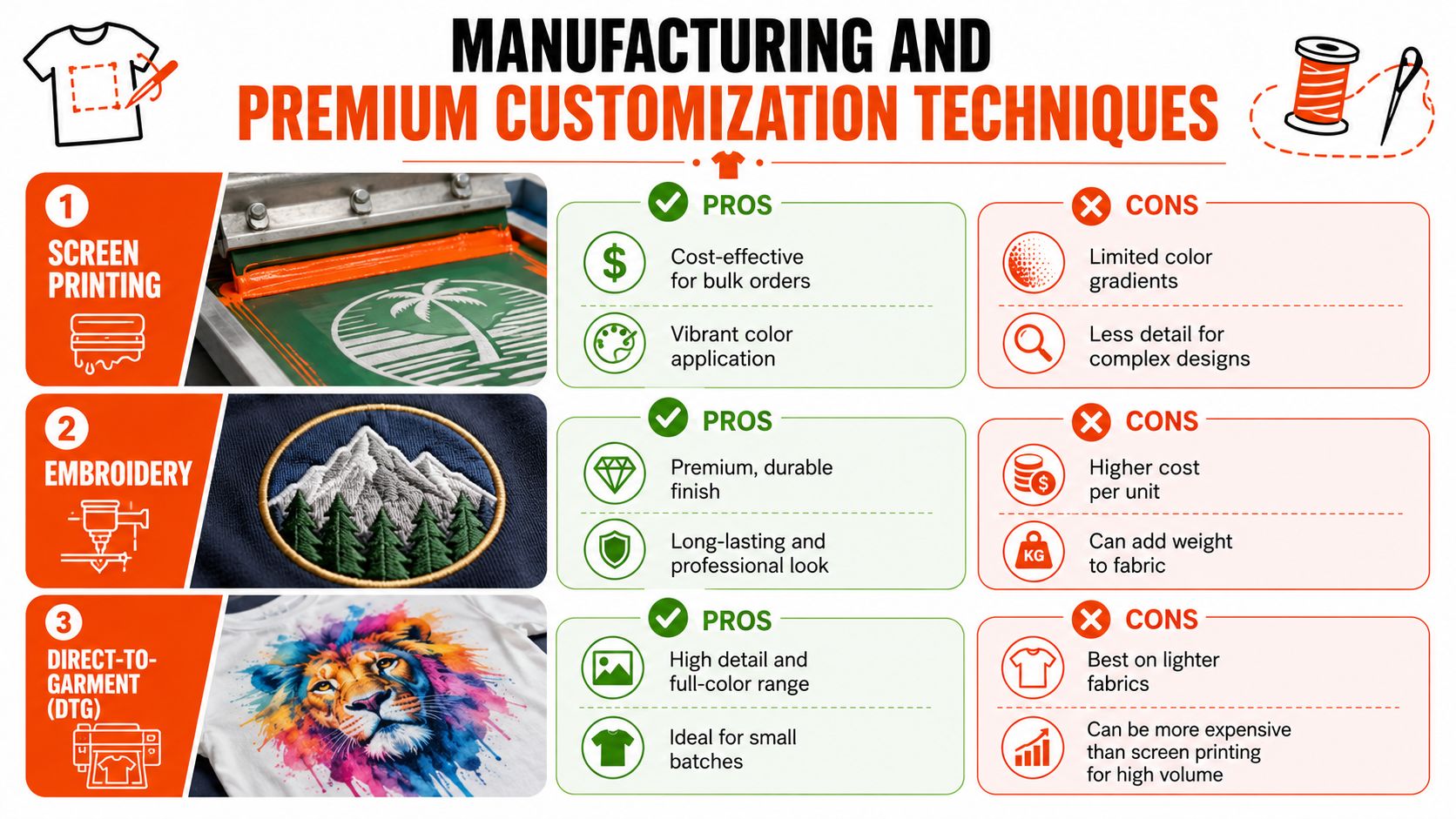
Choose the method that matches the story
Premium brands treat decoration the same way they treat silhouette and fabric. Each method carries a different visual language, a different cost structure, and a different tolerance for mistakes.
| Method | Best for | What it feels like |
|---|---|---|
| Screen printing | Bold graphics, larger runs, punchy visuals | Classic, graphic, confident |
| Embroidery | Small marks, headwear, heritage cues, tactile logos | Durable, refined, structured |
| DTG or DTF | Detailed art, multi-color imagery, short runs | Precise, flexible, more digital |
Embroidery works best when the branding needs restraint. Left chest logos, tonal icon marks, cap applications, and understated placement usually look stronger in thread than ink. It gives the piece weight, both physically and visually.
Screen printing earns its place when the graphic carries the product. Oversized back prints, sleeve hits, cracked ink effects, and statement artwork usually need the density and presence of a proper screen print. Ink chemistry matters here. Water-based, discharge, and plastisol each create a different hand feel, and the wrong choice can make a premium blank feel like promo stock in ten seconds.
DTG and DTF solve a real problem for smaller runs. They let a founder test detailed artwork without committing to larger print minimums. The trade-off is tactile quality and longevity. If the file prep is weak or the garment is too light, the result looks technical instead of considered.
That trade-off matters more than founders expect.
Low-MOQ production only works for a premium startup clothing line if the customization choices still support the brand thesis. Saving money on setup means very little if the final garment photographs flat, ages poorly, or feels disposable in hand. That is why the strongest early-stage brands keep the decoration system narrow and intentional. One excellent print method and one clean trim package usually outperform a menu of five average add-ons.
The details people notice late
Premium perception often comes from the parts founders approve too quickly.
- Custom neck labels signal authorship and help the garment feel proprietary.
- Woven hem tags carry identity without forcing the logo into the main graphic area.
- Hang tags and packaging set the tone before the customer even tries the piece on.
- Consistent finishing keeps the first run and the reorder feeling like the same product.
A hoodie does not feel premium because one feature looks expensive. It feels premium because the fabric, print, labeling, and finishing all agree with each other.
If you are weighing the jump from decorated blanks into full product development, this breakdown of cut and sew manufacturing for custom apparel brands shows where fit, label architecture, and trim control start to become real brand assets.
One more practical note. Visualization matters once you start selling online, especially with premium product where customers care about drape, proportion, and placement. Reviewing newer virtual clothing try-on strategies can help you present customization more clearly before a customer commits.
The Launch and Fulfillment Playbook
A strong garment can still disappear if the launch is sloppy. That happens all the time. Founders spend months on design, then post the drop once, send a rushed email, and hope the product sells itself.
It won't.
The biggest startup killers in fashion are operational. 44% of failures happen after running out of cash, and 22% happen because of a weak marketing strategy, which is why your go-to-market plan has to match your financial runway from day one (fashion startup failure data).
Launch like a product not like leftover merch
The best startup clothing line launches behave more like software releases than passive catalog uploads.
A simple rollout structure works:
- Seed the line before it's available. Show texture, fit, close-up trims, and how the piece sits on body.
- Make the first drop tight. One hero hoodie and one tee often beats a cluttered six-item collection.
- Give the release a frame. Team offsite. product milestone. community reward. seasonal capsule. conference drop.
- Control the first impression. Product page photography, naming, sizing guidance, and copy all need the same level of intent as the garment.
If fit hesitation is likely, it's smart to review newer virtual clothing try-on strategies that can reduce uncertainty before purchase, especially for online-first launches where texture and silhouette are harder to communicate.
Your launch calendar should protect cash, not just create noise.
Fulfillment shapes brand perception
Packaging and shipping aren't back-office details. They're part of the product.
A great line loses aura fast when it shows up late, crushed, badly folded, or sent in anonymous packaging. A simpler line can feel better than expected when the delivery experience is clean and thought through.
Focus on three layers:
- Primary presentation. Fold, bag, wrap, and insert cards.
- Operational reliability. Accurate picking, size accuracy, clear reorder setup.
- Distribution logic. Single-address bulk, individual customer shipments, team gifting, creator sends, community rewards.
A fulfillment partner can remove real friction. For teams shipping to distributed staff or global communities, merch fulfillment services can help manage storage, multi-address delivery, and repeat shipments without turning your office into a warehouse.
If you want your startup clothing line to feel premium, the last mile has to act premium too.
Your Startup Clothing Line FAQ
Most founders don't get stuck on the big idea. They get stuck on the practical unknowns. Minimums. timelines. reorders. product imagery. Those details decide whether a line stays an idea or becomes a repeatable system.
Frequently asked questions
| Question | Short Answer |
|---|---|
| What does low MOQ actually mean for a startup clothing line? | It usually means you can launch without committing to large inventory bets, but you still need to confirm how sizes, colors, and decoration methods can be mixed. |
| Should I start with blanks or custom manufacturing? | Start with blanks if your differentiation is mostly in quality, decoration, and brand feel. Move to custom manufacturing when fit and construction are central to the concept. |
| How long should I expect from concept to delivery? | It depends on sampling complexity, approvals, customization method, and shipping setup. The cleanest timelines come from fewer SKUs and faster decision-making. |
| How do I handle reorders without chaos? | Lock your approved specs early. Keep artwork files, placement notes, trim details, and packaging standards organized so the second run doesn't drift from the first. |
The questions behind the questions
The anxiety around MOQs is usually cash-flow anxiety in disguise. Founders want flexibility because they don't yet know which size curve, color, or silhouette will hit. That's normal. The fix isn't guessing harder. It's building the first line so learning happens quickly and expensive mistakes stay contained.
Timeline stress usually comes from too many variables. Multiple silhouettes, too many colorways, custom trims everywhere, and late-stage design changes drag production out. The cleaner move is to launch narrow and make your first reorder the moment where expansion earns its place.
For product imagery, don't wait until the garments arrive to think visually. If you're shaping product pages before samples are fully in hand, these AI product photography techniques are a useful reference for building cleaner presentation concepts and testing visual direction.
A startup clothing line works when the founder treats every decision as connected. Product, production, pricing, launch, and fulfillment all compound in either direction.
If you want a production partner for a startup clothing line that needs premium blanks, low minimums, custom trims, packaging, and worldwide fulfillment, Banger is one option to consider. You can request a quote, review product previews, and build merch your team will want to wear.