Mastering Leather Goods Manufacturing in 2026
You're probably here because you've seen the gap firsthand. One leather notebook cover or wallet sample arrives looking clean, substantial, and giftable. The next one feels plasticky, limp, over-branded, and somehow older than the day it showed up. Both were sold as “premium leather.”
That's the problem. In leather goods manufacturing, the material label alone tells you almost nothing about how the final piece will feel in hand, wear over time, or represent your brand. If you're buying for a team drop, client gifting, retail merch, or event kits, the wrong call doesn't just waste budget. It makes your brand look less considered than it is.
Table of Contents
- Is full-grain always the best option
- What's the difference between embossing and debossing
- Is vegan leather more sustainable
- Do I need a tech pack for leather goods
- What's the most common mistake buyers make
- How can I make a custom leather item feel more premium without overbuilding it
Why Most Custom Leather Goods Miss the Mark
Most bad custom leather goods fail long before anyone opens the box. The buyer approved a sample that looked fine in photos, signed off on a spec sheet with vague language, and trusted “genuine leather” to do more work than it ever could.
That's how you end up with wallets that crease badly, card holders with mushy edges, and branded pouches that photograph well for a week and then start reading like conference swag. The category is bigger and more industrial than a lot of buyers assume. One industry estimate projects the global leather goods market to reach USD 982.42 billion by 2034, growing at a 7.13% CAGR from 2026 to 2034, according to leather industry market projections. This isn't a tiny craft niche. It's a huge supply chain with wide variation in quality.

What bad leather merch usually gets wrong
The pattern is familiar:
- Material language is too vague. “Leather” can describe very different substrates, finishes, and performance outcomes.
- Branding gets over-prioritized. Buyers focus on logo size before edge paint, stitch density, or structure.
- Samples hide scaling issues. One prototype can look solid while the production run falls apart on consistency.
- The product fights the use case. A soft handfeel sounds nice until the pouch needs to hold shape in transit.
Cheap-looking leather goods rarely fail because the logo was wrong. They fail because the structure, finish, and material spec were weak.
For modern brands, that matters more than ever. If you're producing many SKUs, seasonal variants, or campaign-specific accessories, the operational side matters too. Some of the best lessons come from adjacent manufacturing disciplines, especially strategies for high mix production, where consistency across varied product runs matters as much as craftsmanship.
If you want a better baseline before briefing vendors, the Banger merch blog is a useful place to study how product decisions affect brand perception across categories, not just leather.
What a premium piece does differently
A good leather product doesn't need to scream. It feels stable, intentional, and proportioned right. The cut lines are clean. The edge work doesn't look gummy. The hardware has weight. The branding feels like part of the object, not a sticker in another form.
That's the standard to buy against. Not “is it leather,” but “does every manufacturing choice support the product I'm trying to put into the world?”
The Source Code Leather and Tanning
Leather quality starts before the factory floor. It starts with what part of the hide is used, how it's processed, and what the tannery optimized for. Buyers who skip that layer usually end up judging leather by surface appearance alone, which is where a lot of expensive mistakes begin.
The industry itself sits inside a much bigger supply chain than most merch buyers realize. The leather sector uses over 95% of its raw materials from by-products of the meat and dairy industries, as noted in this FAO-backed leather industry analysis. That's one reason sourcing, tanning, and manufacturing are so globally interconnected.
Leather is not one thing
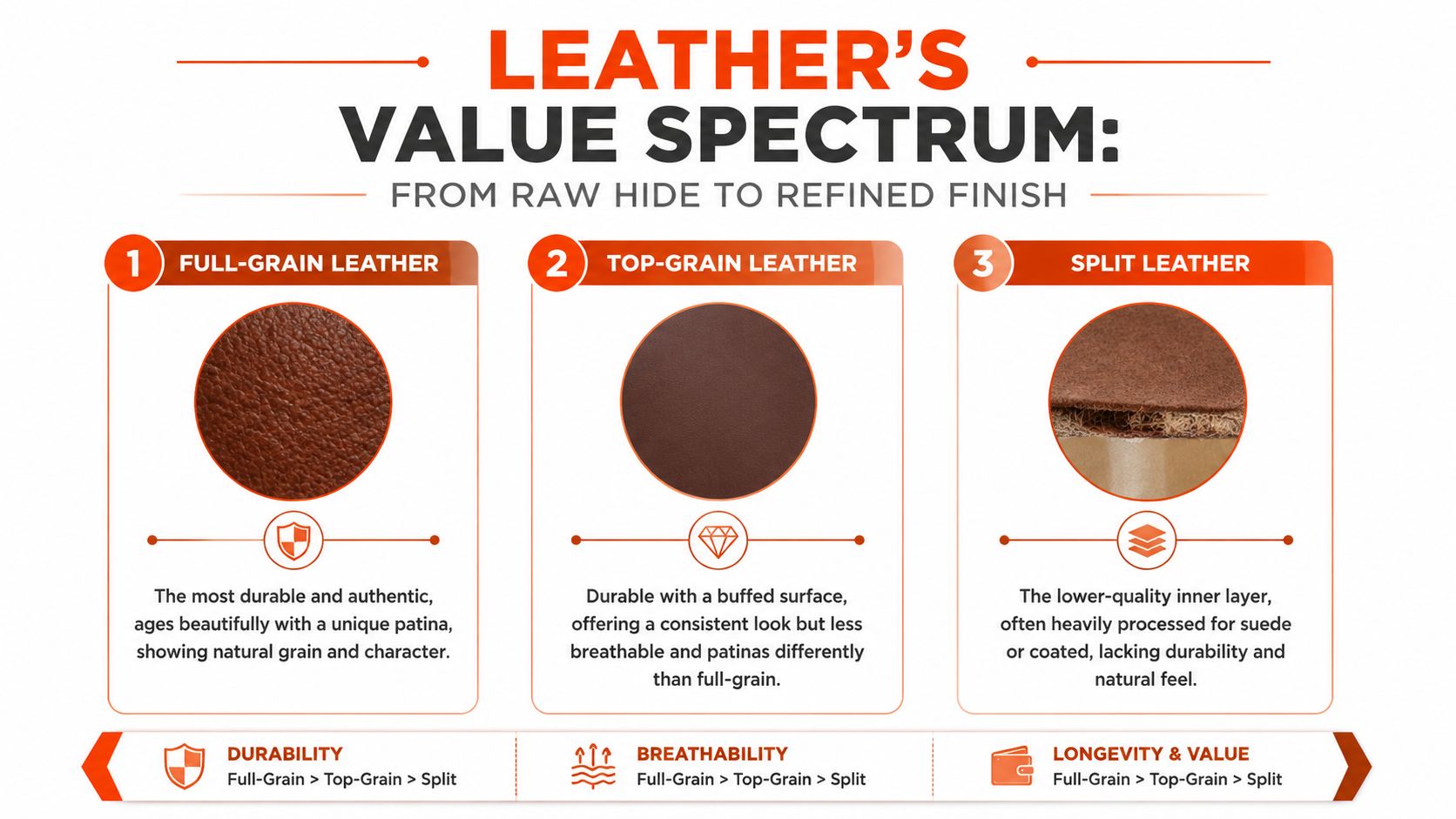
If you only remember one distinction, make it this one. Full-grain, top-grain, and split leather do not behave the same way.
Full-grain is the closest thing to raw denim in leather terms. It keeps the natural grain, shows character, and tends to age in a way people like. If your brand wants pieces that develop patina and feel more personal over time, this is usually where the conversation starts.
Top-grain is more corrected. It can still be excellent, especially when you need a more uniform look across a run. It often makes sense for projects where consistency matters more than natural variation.
Split leather is the lower layer. It can work for the right application, especially when heavily finished or used for suede-like effects, but it won't give you the same structure, feel, or longevity as stronger top layers.
A simple buyer view helps:
| Leather type | Best for | Trade-off |
|---|---|---|
| Full-grain | Premium gifting, small accessories, pieces meant to age well | More natural variation |
| Top-grain | Cleaner brand presentation, scalable runs, smoother finish | Less character over time |
| Split | Cost-sensitive projects, coated fashion looks, certain soft applications | Lower durability and less natural feel |
Tanning changes the product before design does
A lot of teams think design starts with the silhouette. In practice, design starts with the tannery spec.
Leather manufacturing is broadly organized into preparatory stages, tanning, and crusting or finishing. The post-tannage stage adds syntans, fatliquors, and dyes, and that's what determines the final handfeel, color, and surface durability, according to Nera Tanning's leather process guide. By the time the hide reaches cutting, a huge amount of the product's personality is already locked in.
That's why two pieces with the same shape can feel completely different in hand.
Buyer shortcut: Ask what the tannery optimized for. Softness, structure, color depth, scratch resistance, or natural grain visibility. If the answer is vague, the sample probably won't scale well.
Vegetable-tanned leather usually brings a firmer, more organic character. It can age beautifully, but it also asks for design discipline. Chrome-tanned leather often offers more softness, color flexibility, and production convenience. Neither is automatically “better.” They fit different jobs.
If sustainability is part of the brief, the conversation also gets more nuanced than simple material labels. In this context, adjacent product categories can help frame decisions. The guide to environmentally friendly promotional items is useful because it pushes the conversation beyond surface-level claims and toward actual product lifespan and use.
The Blueprint From Pattern to Product
A buyer signs off on a clean sample. Production starts. Then the first bulk units come back with swollen edges, drifting stitch lines, and panels that no longer sit square. That gap usually starts in the blueprint, not at final inspection.
A leather good only looks simple after the hard decisions have been made well.
Where quality gets built in
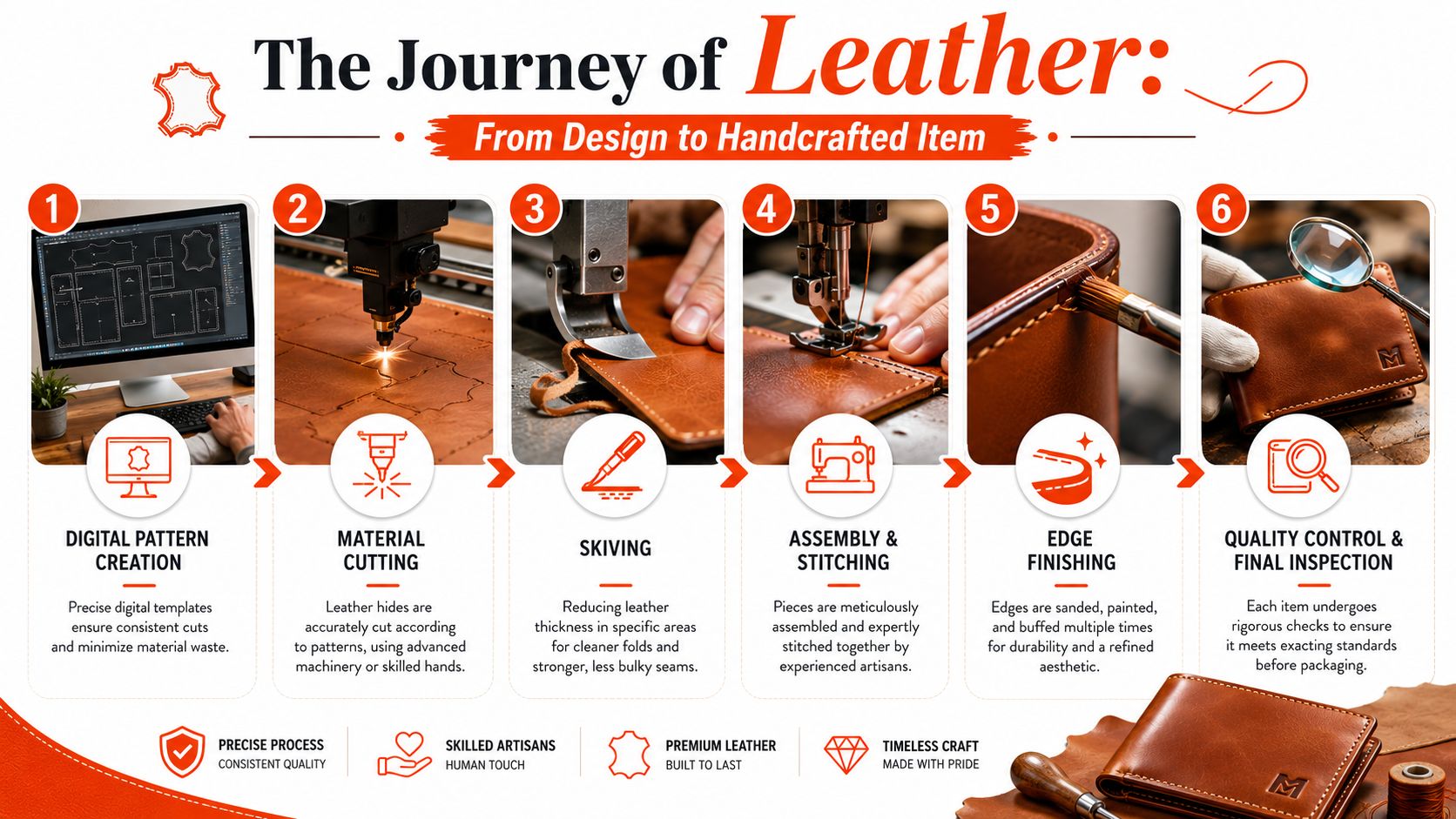
The pattern is the control document. It sets seam allowance, fold direction, reinforcement zones, lining tolerance, and how the product will behave once the leather is turned, stitched, and pressed. A sketch can sell the concept. The pattern decides whether it can be made cleanly at scale.
Good factories prototype early for a reason. The first sample answers basic questions. The second should solve construction problems. By the third, the team should be tuning details like opening resistance, pocket depth, edge thickness, or strap drop. If a supplier rushes from concept to salesman sample without working through those steps, buyers usually pay for it later in rejects, rework, or disappointing bulk.
Cutting method changes both cost and consistency:
- Die-cutting makes sense for stable volume and repeatable shapes.
- Laser-cutting suits intricate geometry, but some finishes and edge conditions need careful testing first.
- Hand-cutting works for development, small runs, and hides where the cutter needs to read grain, scars, and stretch before placing parts.
Skiving is one of the clearest markers of technical competence. Reduce too little and the product feels thick and stubborn. Reduce too much and stress points fail early. The right skive lets folds close neatly, corners sit tighter, and layered constructions keep their shape without looking padded.
Stitching decisions matter too. Machine stitching gives speed, consistency, and lower unit cost. Hand stitching takes longer and costs more, but it can be the right call for small luxury runs, visible repairability, or categories where that craft signal supports the brand story. Neither option is necessarily premium. The construction has to fit the price point, expected wear, and customer expectation.
Teams building across categories can use the cut and sew manufacturing FAQ to compare how pattern logic, tolerances, and production sequencing carry over from apparel into accessories.
What buyers should pay attention to
The biggest sampling mistake is judging only the silhouette. Buyers should open the piece, flex it, load it, and check where thickness stacks up. Corners, strap bases, zip ends, turned edges, and card slots reveal more than the hero shot ever will.
Ask to see what changed between prototype rounds. A strong manufacturing partner can explain why a panel was split, why a reinforcement moved, or why a fold needed a thinner temper. If the explanation is vague, the sample was probably built from habit instead of product intent.
Process visibility helps. A short line video will not prove quality on its own, but it does show whether the workshop handles material in a controlled sequence or improvises from table to table.
For teams comparing finishing approaches across categories, LC Proto's finishing services gives useful context on how surface treatment decisions affect appearance, durability, and production fit.
The Details Hardware Finishing and Branding
Premium products separate themselves from decent ones. Not in abstract “craftsmanship,” but in concrete details buyers can inspect.
Small components shape perceived value
Hardware does heavy lifting for both feel and trust. A zipper with clean movement, a snap with consistent closure, or a ring attachment that doesn't feel flimsy changes how people judge the whole item. Even when the leather is good, weak hardware makes the product feel compromised.
Edge finishing is another tell. A painted edge can look sharp and modern when it's smooth, even, and built up properly. A turned or folded edge feels different. Usually softer, often more classic, sometimes bulkier depending on the construction. Neither is universally superior. The question is whether the technique suits the product.
When buyers review samples, this checklist catches more than most moodboards do:
- Check edge consistency. Look for waviness, cracking risk, excess paint, or rough transitions at corners.
- Test the hardware. Open and close it repeatedly. Feel for looseness, scraping, or inconsistent pressure.
- Inspect stitch paths. Curves should stay clean. Backstitching should look intentional, not messy.
- Look at stress points. Strap anchors, folded tabs, and corners reveal whether reinforcement was thoughtful.
For teams that need to understand finishing more broadly across materials, LC Proto's finishing services give a useful high-level frame for how surface treatments affect appearance, durability, and touch.
Branding should feel integrated not pasted on
Branding on leather works best when it respects the material. Blind embossing can feel quiet and premium. Debossing adds depth. Foil can look great when used with restraint and when the leather surface supports it.
Bad branding usually shows up in one of three ways:
| Branding choice | When it works | When it falls apart |
|---|---|---|
| Embossing | Minimal marks, tonal branding, soft luxury feel | Weak pressure or poor placement |
| Debossing | Deeper brand presence with tactile detail | Soft leather can distort around the mark |
| Foil stamping | Sharp contrast, more visibility, giftable look | Cheap foil or wrong surface can wear badly |
A useful parallel exists in apparel trims. If you've ever compared woven labels and printed labels, you already know how much branding method changes perception. The same logic applies here, and the screen printed labels guide is a good reminder that branding is a construction decision, not just a graphic one.
The Cost Equation MOQs Lead Times and Pricing
Most leather quotes look mysterious until you break them into a few real drivers. The price usually isn't random. It reflects material choices, construction complexity, hardware, sampling friction, and how disciplined the production setup is.
What actually moves the quote
Material is the first lever, but it's not the only one. Buyers often focus too hard on leather grade and miss the cumulative effect of all the smaller decisions.
Cost usually climbs when you add:
- More panels and tighter tolerances. Complex construction takes more cutting, more handling, and more opportunities for variance.
- Special hardware. Custom pulls, branded snaps, unusual finishes, and non-standard fittings can slow sourcing.
- Heavy edge work. Painted edges that need multiple passes look better, but they also add labor.
- Custom packaging. Good for gifting. Expensive when added late without planning.
- Low-volume uniqueness. Bespoke details become less efficient when every unit changes.
Lead time follows a similar logic. It's not only about how fast the atelier sews. It's also about whether leather, hardware, lining, cartons, and trims arrive in sync.
One independent guide puts it plainly. Production efficiency in leather goods manufacturing comes from modular components, consistent leather thickness, and visibility into supplier lead times, as explained in this production efficiency guide for small leather goods.
How to reduce cost without making the product worse
The best cost cuts usually happen at the design stage, not after the sample disappoints.
Practical rule: Simplify the architecture, not the experience. Reduce hidden complexity before you downgrade the material people actually touch.
A few moves usually help:
- Standardize components where possible. Shared zipper sizes, common linings, and repeatable pocket constructions make production cleaner.
- Choose one hero detail. Let the leather, edge, or hardware carry the premium signal. Don't make every part custom.
- Design for consistency. A product that tolerates natural material variation will run better than one that demands visual perfection from every hide.
- Lock the use case early. A gifting wallet, event credential holder, and travel pouch should not be spec'd the same way.
If MOQ pressure is part of the problem, the low MOQ custom apparel FAQ is useful as a broader buying reference. Different category, same core lesson. Small runs only work when the product architecture is disciplined.
How to Partner with the Right Atelier
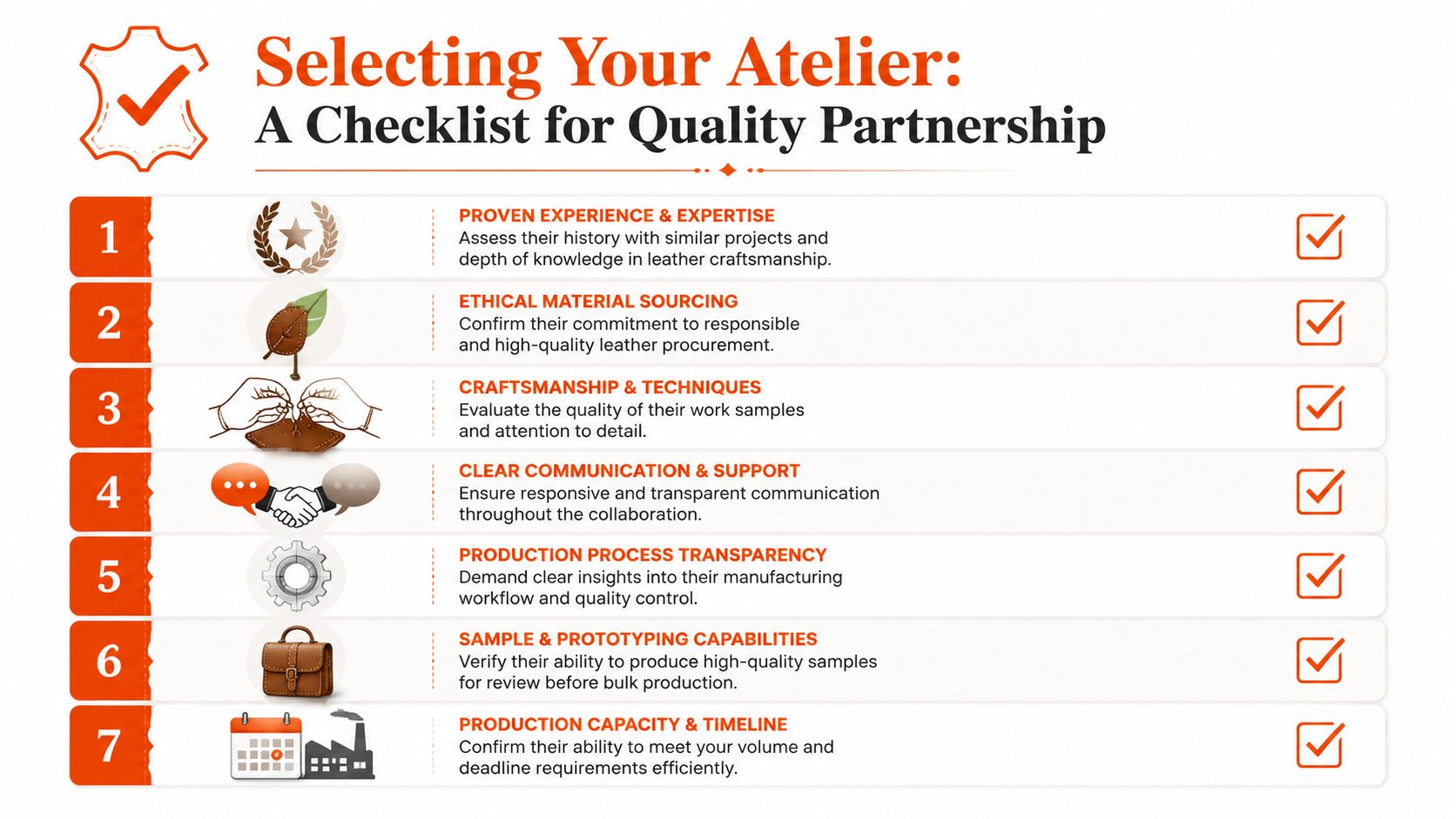
A polished sales deck doesn't tell you much about how a workshop thinks. The right atelier shows its strength in process language, sample discipline, and how specifically it answers technical questions.
Questions that reveal real capability
A strong vendor should be able to talk clearly about leather behavior, not just offer a menu of finishes. One of the best filters is moisture control. Expert manufacturers often dry leather to roughly 14 to 25% moisture, then condition it back to about 18 to 28% before cutting and sewing, according to Leather Naturally's manufacturing reference. That window affects stitch quality and dimensional stability.
Ask direct questions like these:
- How do you control leather moisture before cutting and assembly?
- What variation do you accept between hides in the same production run?
- Where do you reinforce stress points on this product type?
- Which branding method suits this leather finish, and which one would you avoid?
- What usually causes delays on projects like this?
- How do you handle replacements if a hardware batch arrives inconsistent?
If the answers stay generic, that's useful information.
Green flags in the sampling stage
The sampling phase tells you more than the final sales call ever will. Watch how the atelier responds when you push beyond moodboard language.
Good signs include:
| Signal | What it usually means |
|---|---|
| They challenge a weak spec | They care about manufacturability, not just winning the order |
| They offer material alternatives with reasoning | They understand end use |
| They flag edge cases early | Their QC mindset is active before production |
| They annotate the sample review | Their process is documented and repeatable |
The best ateliers don't just say yes. They tell you which details will age badly, which corners will fail, and which finishes won't survive your use case.
You should also pay attention to communication style. Fast replies matter less than precise replies. A delayed but technical answer beats a same-day “no problem” that ignores the hard parts.
FAQ Your Leather Goods Questions Answered
Is full-grain always the best option
Not automatically. Full-grain is often the strongest choice when you want natural character and long-term wear, but some projects need a cleaner, more uniform look. Premium doesn't always mean the most natural surface. It means the material fits the product.
What's the difference between embossing and debossing
Embossing raises the mark relative to the surface. Debossing presses it in. On leather goods, buyers often use “embossing” loosely for both, so it's smart to ask for a visual sample and a clear mockup.
Is vegan leather more sustainable
The honest answer is that it depends on what you value and how the product will be used. The trade-off is real. Demand for vegan and synthetic options is rising due to ethical concerns, while full-grain leather is projected to remain dominant in part because durability supports a buy-less, buy-better model, according to IBISWorld's leather goods industry coverage.
Do I need a tech pack for leather goods
For anything beyond a very simple product, yes. It doesn't need to be bloated, but it should define dimensions, panel construction, materials, finishes, hardware, branding placement, and packaging expectations. Good leather goods manufacturing depends on specifics.
What's the most common mistake buyers make
Approving a sample based on looks alone. A leather sample should be reviewed for structure, edge quality, hardware feel, stitch consistency, and how the branding interacts with the material.
How can I make a custom leather item feel more premium without overbuilding it
Choose one thing to do very well. Better leather, sharper edge finishing, or more considered branding will usually outperform a design loaded with too many features.
If you want to build leather goods that feel considered from the first sample to final delivery, Banger can help. We produce premium custom merch for internet-native teams, with fashion-grade execution, low minimums, and French atelier craftsmanship. Request a quote and get product previews within 24h.