Company Branding Clothing That People Actually Wear
Most advice on company branding clothing starts in the wrong place. It starts with logo size, print method, or which blank is cheapest in bulk.
That's backwards.
The question isn't "what should we put our mark on?" It's "would anyone wear this if they didn't work here?" If the answer is no, you're not building branded apparel. You're ordering landfill with a shipping label.
That matters because apparel isn't a niche promo item. It sits inside a huge, constantly refreshed global category. The fashion industry generates an estimated $1.7 to $2.5 trillion in global revenue, produces over 100 to 150 billion garments per year, and consumers buy more than 80 billion new pieces every year — over 400% higher than two decades ago, according to global fashion industry statistics from FashionUnited. That's why clothing remains such a durable branding surface. It already has a place in people's lives, wardrobes, routines, and daily habits.
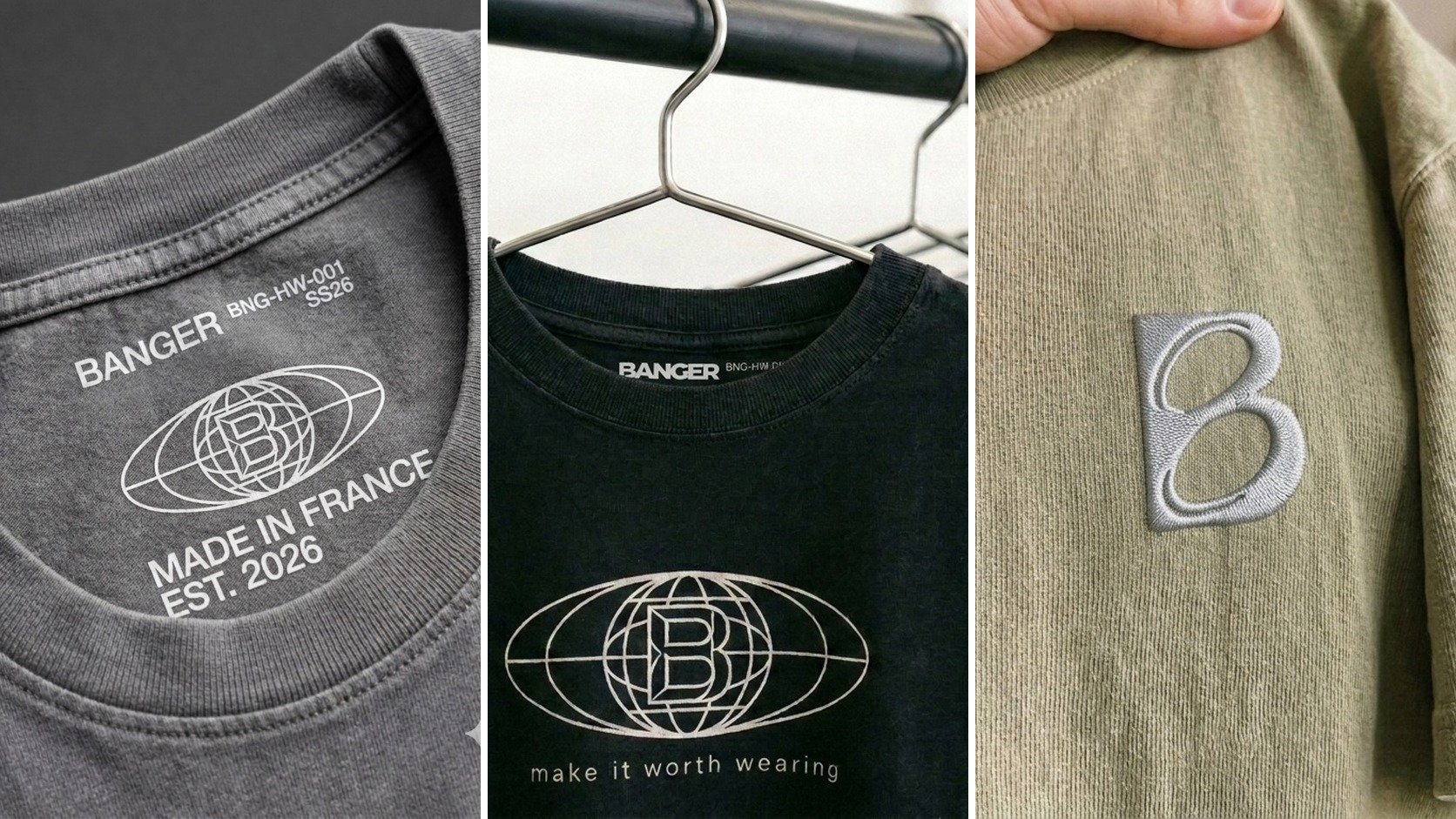
Here's what that looks like across three of our own pieces. On the left, a screen-printed inside neck label that replaces the manufacturer's tag. In the middle, a heavyweight washed black t-shirt with the same globe screen-printed front and center, paired with the tagline "make it worth wearing." On the right, a flat embroidery of the Banger B in tonal thread on a garment-dyed sage green tee - heavyweight cotton, washed for that lived-in texture. Three techniques, one logic. Custom inside labels, screen printing, embroidery -every choice made so the garment reads as part of a real wardrobe, not as company-issued uniform.
Good company branding clothing works like a cultural artifact. It makes a team feel sharper. It makes a community feel seen. It gives remote employees something physical that says "I'm part of this." And if you get the garment, the fit, and the finishing details right, it can do all of that without looking like conference swag.
Table of Contents
Start with the Vibe Not Just the Logo
The strongest company branding clothing doesn't begin with decoration. It begins with intent.
If a startup says, “we need some swag for the team,” that's usually a sign nobody has done the hard thinking yet. What kind of signal should the piece send. Internal pride. Founder energy. Clean operator aesthetic. Community belonging. Event exclusivity. If that part is fuzzy, the output will look generic no matter how expensive the garment is.
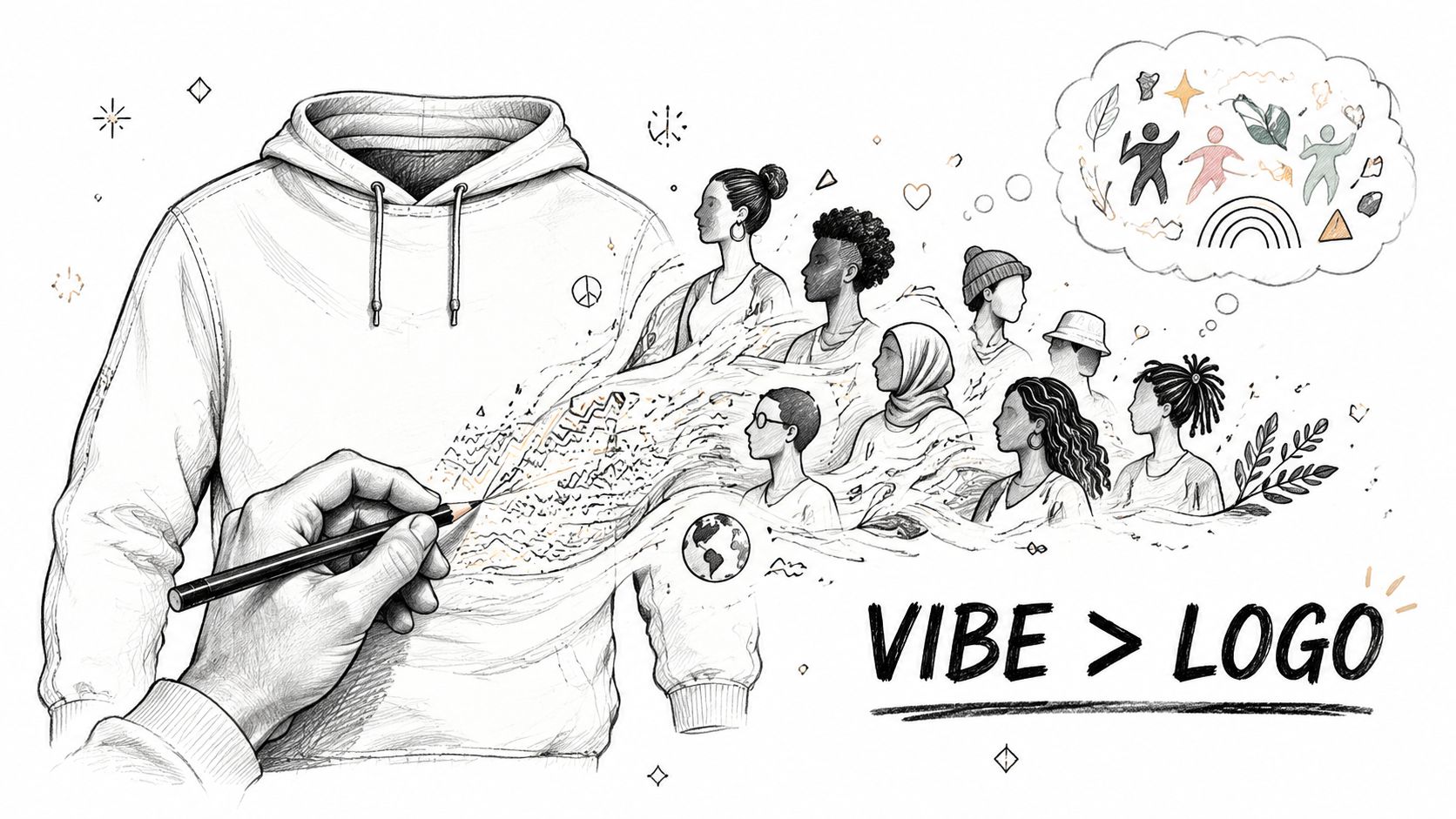
Merch fails when the brief is lazy
Most bad merch briefs sound like this:
Need: A hoodie or tee for the team
Branding: Add logo
Audience: Everyone
Goal: Visibility
That's not a brief. That's procurement.
A better brief sounds more like a fashion brief. It names the audience, the context, and the emotional tone. An onboarding kit for a remote fintech team should not feel like a conference freebie. A limited tee for a dev conference should not look like employee uniform. A community gift for a crypto protocol should not feel like old-school corporate merch with a token pasted on the chest.
Practical rule: If the only idea is “put the logo bigger,” the concept is weak.
There's also a branding reason to care. Apparel has an 85% brand recall rate, and 77% of consumers purchase based on brand name, according to Tailor Brands' branding statistics. That makes clothing a long-lived brand asset, not just a nice-to-have giveaway. But recall only helps if the item stays in rotation.
Define the role before the product
A clean way to frame company branding clothing is to decide what job the piece needs to do.
| Merch use case | What it should feel like |
|---|---|
| Onboarding kit | Welcoming, elevated, easy to wear weekly |
| Team offsite apparel | Cohesive, relaxed, photo-friendly |
| Conference drop | Distinctive, limited, conversation-starting |
| Community reward | Insider-coded, not overly corporate |
That's where aesthetics start to matter in a practical way. Color, silhouette, and finishing details should match the role. A washed heavyweight tee says something different from a slick performance polo. A tonal chest hit says something different from a loud center-front print.
For teams building their identity from scratch, it helps to think more like a label and less like an office manager. This is the same shift that turns a startup concept into a real line. The thinking behind that is similar to building a startup clothing line with a clear point of view.
A good drop creates a feeling first. The logo comes after.
Your Guide to Premium Garments and Materials
People don't keep merch because the brand paid for it. They keep it because the garment earns a place in the wardrobe.
That's the part most corporate merch conversations skip. They talk decoration before they talk body, fabric, hand feel, collar shape, rib recovery, wash behavior, and whether the piece looks good with normal clothes. If the blank is wrong, the project is already compromised.
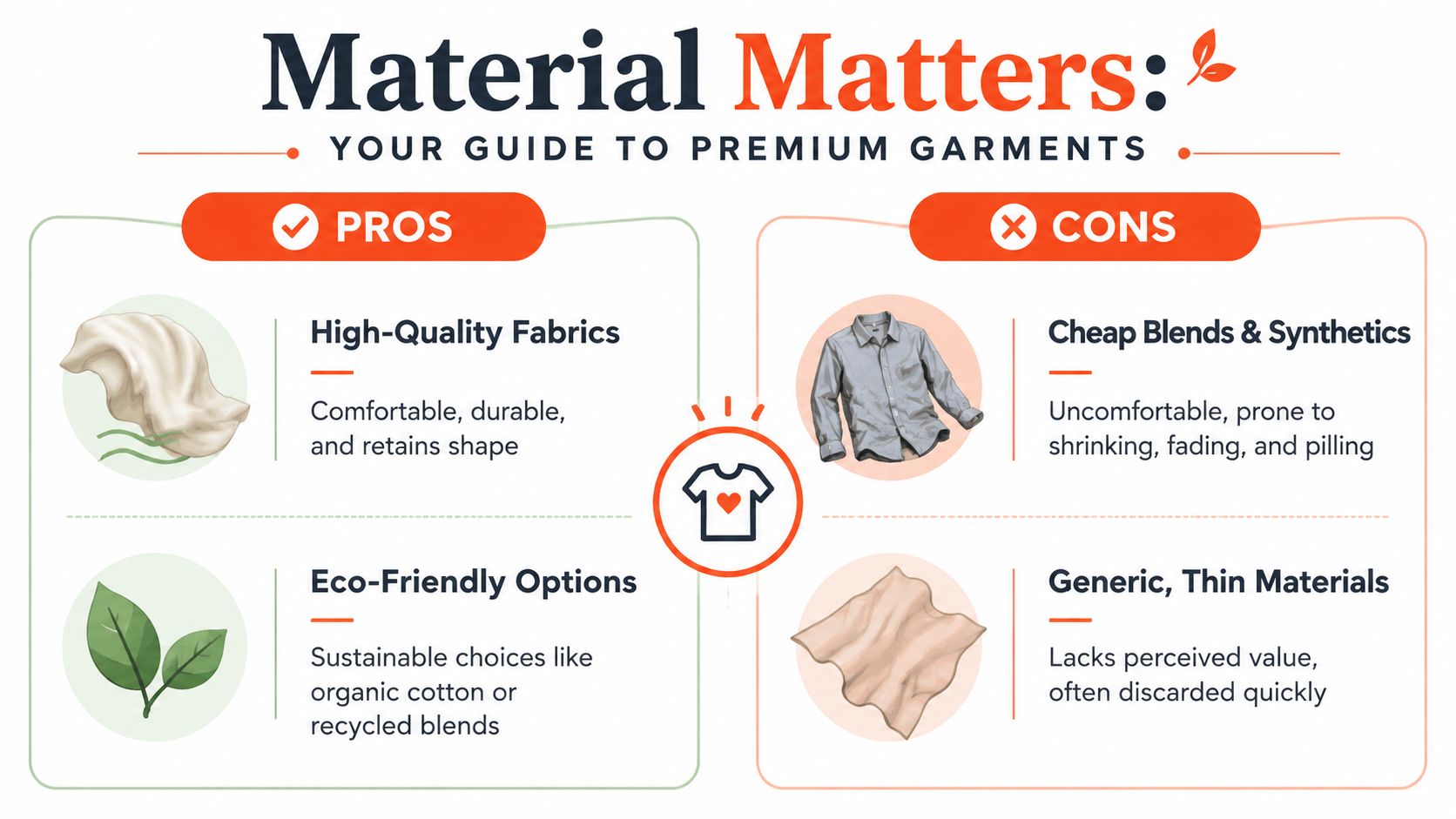
The blank decides the outcome
Premium company branding clothing usually comes down to three variables.
Fit: Boxy, relaxed, cropped, oversized, classic. Fit carries the vibe before anyone notices the logo.
Fabric: The hand feel tells people instantly whether this is real apparel or disposable merch.
Construction: Ribbing, stitching, hood structure, cuffs, neckline, and weight decide whether the piece feels substantial.
The biggest mistake is choosing by unit cost alone. Cheap blends, thin jerseys, and stiff synthetic-heavy fabrics nearly always read as promo product. Even when the print is clean, the body feels wrong. It twists, pills, loses shape, or lands awkwardly on the body.
By contrast, a heavier cotton tee with good structure can carry minimal branding and still feel intentional. A hoodie with dense fabric, a clean hood shape, and sturdy ribbing feels closer to something from a fashion label than something ordered from a giveaway catalog.
Better merch starts with a garment someone would buy without the logo.
Material quality also changes the economics after delivery. A 2024 McKinsey report indicates that fashion items with higher perceived quality and comfort are worn 3x more often than generic alternatives, with a 60% reduction in single-use waste. For company merch, that's the cleanest argument for cost-per-wear over cheap unit pricing.
For hoodies specifically, the right blank makes almost every design decision easier. If you're comparing cuts, finishes, and heavier options, this guide to the best hoodie blanks is a useful starting point.
What to check before you approve a garment
A simple quality review saves a lot of regret later.
Touch the fabric first
Ignore the mockup for a minute. Is it soft, dry, brushed, weighty, crisp, or plasticky? The hand feel tells the truth fast.Check shape retention
Look at collar rebound on tees and cuff recovery on hoodies or crewnecks. If the structure collapses early, the piece will age badly.Review the silhouette on body
Flat product shots hide bad proportions. Ask how the tee sits at the sleeve, shoulder, and hem. Ask how the hoodie stacks at the cuff and waist.Study the inside as well as the outside
Seams, taping, interior brushing, and label finishing matter. Cheap finishing gives itself away quickly.Think about decoration compatibility
Dense embroidery on a lightweight tee can distort the chest. Large prints on unstable fabric can crack or warp. The garment and graphic need to agree.
Here's the blunt version. If the piece feels cheap before branding, branding won't rescue it.
Designing Merch for Internet-Native Culture
Loud logos are usually a tell. They signal procurement, not taste.
The internet-native version of company branding clothing works differently. The goal is not maximum brand visibility at every angle. The goal is to make something your team would wear on a weekend, post without irony, and keep in rotation long after the event, launch, or onboarding box.
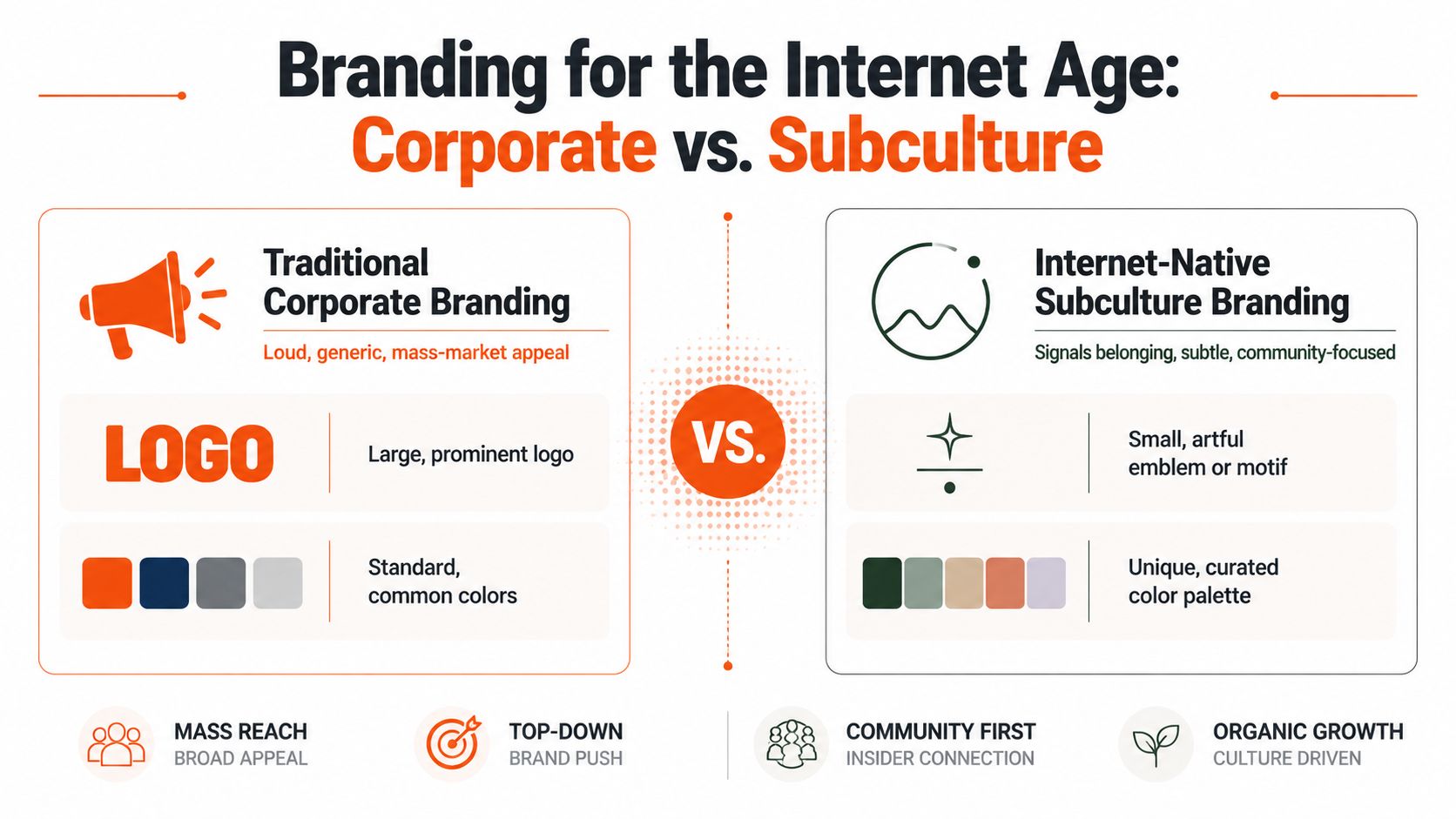
Silent branding beats billboard branding
The best startup merch rarely leads with a giant chest hit. It wins through proportion, restraint, and details that feel native to the garment.
That shift matters because branded apparel now competes with real clothes, not just other swag. If a tee looks like conference giveaway stock, it gets worn once. If it feels like a considered piece, it earns repeat wear and better brand recall without begging for attention.
The strongest moves are usually subtle:
Tonal embroidery on the chest, sleeve, or cuff
Back-of-neck marks instead of a centered front logo
Custom woven hem tags that feel built into the garment
Abstract graphics that reference the brand language without spelling everything out
Printed neck labels that replace generic blank branding
Merch starts to function as product design. Recognition comes from composition, placement, and finish.
Teams often have a sharp visual identity but no system for translating it into apparel. If you need help turning brand assets into garment-ready concepts, custom design services for branded apparel can close that gap.
Choose decoration like a designer, not a buyer
A logo can look clean in Figma and still fail on fabric.
Decoration has to match the garment, the artwork, and the use case. Dense embroidery gives a sweatshirt structure and presence, but it can distort a lightweight tee. DTG can hold detail well for artwork-heavy graphics, but the print surface can feel wrong if the base garment already has a premium hand. Woven labels add polish, but bad placement makes the whole piece feel off-brand.
A quick framework helps keep decisions honest:
| Decoration method | Best use | Watch out for |
|---|---|---|
| Embroidery | Caps, hoodies, sweatshirts, tonal branding | Can pucker lighter fabrics |
| Screen print | Bold graphics, larger art, clean flat color | Needs tight artwork control |
| DTF or DTG | Detail-heavy art, gradients, smaller runs | Finish can feel wrong on the wrong garment |
| Woven labels and tags | Quiet branding, elevated finish | Easy to get placement wrong |
The cleanest branded apparel often has the least obvious logo.
One more practical point. Internet-native brands love limited drops, but limited runs still need control on the back end. Clean SKU tracking, reorder visibility, and size-level inventory matter if a piece catches on internally or sells beyond the team. 3DLogistiX inventory solutions are a useful reference point for how operators handle that side without turning merch into guesswork.
The design test is simple. If it reads like free swag, kill it. If it looks like something someone would style with their own wardrobe, it has a shot.
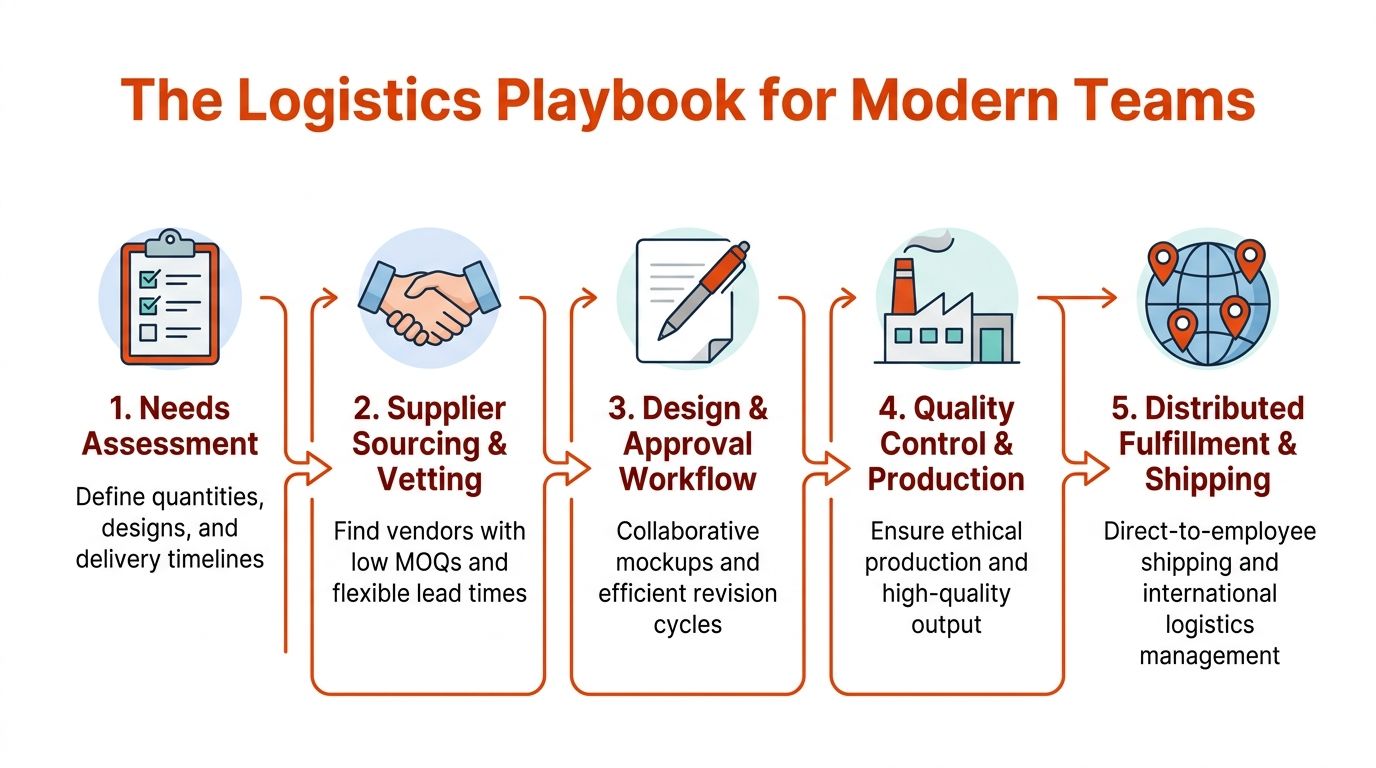
The Logistics Playbook for Modern Teams
A lot of merch projects don't fail in concept. They fail in operations.
The team wants a sharp onboarding kit, a conference drop, or a community send-out. Then reality lands. High minimums. Slow sampling. Messy approvals. One spreadsheet for sizes. Another for addresses. A vendor that can ship to a head office but not to forty people in ten countries. Suddenly the project feels heavier than it should.
Distributed teams break old merch systems
Traditional merch systems were built for one destination. Box everything. Pallet it. Send it to the office. Let someone internal sort the rest.
That model doesn't fit remote hiring, international teams, creator partnerships, or event seeding. Modern teams need lower commitment per SKU, cleaner proofing, and multi-address delivery without turning one drop into a month of admin.
A workable process usually depends on a few things:
Low minimums: So you can make a focused drop instead of overordering.
Clear approval flow: Mockups, revisions, and final sign-off need one owner.
Reliable production timing: Fashion timing matters. Event timing matters even more.
Distributed fulfillment: Individual shipments should be part of the system, not an exception.
If you manage rolling stock, event packs, or repeat internal kits, it also helps to look at tools that keep inventory clean across channels. Teams dealing with recurring storage and dispatch workflows may find 3DLogistiX inventory solutions useful for understanding how e-commerce-style inventory control can support branded goods operations too.
What a clean operating model looks like
The cleanest setup is usually boring in the best way. Product selected. Sizes collected. Mockups approved. Sample confirmed if needed. Production launched. Orders routed to one address or many. Tracking sent. Reorders based on locked specs.
That's why fulfillment matters as much as design. For distributed teams, merch fulfillment services built for multi-address shipping can remove most of the internal coordination that kills momentum.
One practical example is Banger, which handles product customization, production, storage, and worldwide shipping, including multi-address orders for remote teams. That kind of setup makes sense when the team wants apparel to behave more like an operational program than a one-off swag purchase.
A good merch system should reduce internal labor, not create a side job for marketing.
Logistics should make the creative stronger. Not dilute it.
Executing the Drop and Measuring Real Impact
The drop isn't finished when production wraps. The last mile decides whether people feel like they received a product or a box of branded stuff.
The difference shows up fast. One package arrives in a plain shipper with a folded tee tossed in a polybag. Another arrives in a branded mailer with clean tissue, a sharp insert, maybe a sticker sheet, and a garment that feels considered the second it's picked up. Same item category. Totally different effect on the recipient.
The unboxing is part of the product
Good packaging frames the piece before anyone tries it on.
For onboarding kits, that moment matters because it creates a physical welcome. For community drops, it creates shareability. For customer gifting, it turns branded apparel into something closer to product marketing than promotional spend.
A few details usually do the most work:
Mailer boxes: Strong enough to survive shipping and still feel intentional on arrival
Tissue and inserts: Useful for pacing and presentation
Sticker sets or cards: Small add-ons that support the world around the garment
Consistent folds and labeling: Tiny operational details that shape perceived quality
If you're building that layer out, custom packaging design for merch drops is usually worth treating as part of the product, not as an afterthought.
Measure what people actually do
Teams don't need complicated attribution theater. They need proof that the thing got worn, remembered, and talked about.
A practical way to judge impact is to follow a drop through three moments.
First, the reaction. Watch Slack threads, Discord posts, founder group chats, or internal photos after delivery. People tell you quickly whether the piece landed. If nobody posts it, that's a signal.
Second, repeat wear. Ask team leads or community managers what keeps showing up on calls, at offsites, or in selfies from events. Premium branded clothing earns its value over time, not on day one alone.
Third, visibility. FashionUnited notes that the global industry produces over 100 billion garments annually, which is part of why apparel remains such a durable medium, and Doceo reports that a single branded shirt can generate roughly 2,450 impressions. In practice, that means company branding clothing keeps working after the campaign window closes.
Some teams also formalize advocacy around their best pieces. If you want a useful read on how brands structure ambassador-style participation around apparel, the REACH platform guide to clothing brand ambassadors is a relevant reference point.
Track cost per wear, not just cost per unit. Cheap merch often looks efficient only before it ships.
The ultimate win is simple. People choose to wear it when they don't have to.
Frequently Asked Questions About Company Branding
Good branded clothing gets decided in the details. The logo is the easy part. The hard part is making the piece look intentional, fit the garment, and reorder cleanly six months later without a quality drop.
That is usually where teams separate into two camps. One group treats merch like a quick print job. The other treats it like product. The second group gets pieces people keep wearing.
Common Questions for Your Merch Drop
The practical tool behind that difference is the tech pack. It is the production file that tells a factory exactly what to make. For branded apparel, that means flat sketches, materials, artwork size, placement measurements, label specs, trim notes, and decoration instructions that match the actual garment. If those details stay scattered across mockups, emails, and Slack threads, mistakes show up fast.
| Question | Short Answer |
|---|---|
| What is a tech pack for branded apparel? | It is the production file for the garment, artwork, trims, measurements, and build details. |
| Do we need one if we're not doing full cut and sew? | Yes, if you want reliable placement, fewer mistakes, and clean reorders. |
| What should be included? | Flat sketches, bill of materials, artwork size, placement measurements, label specs, fabric details, and trim callouts. |
| Why do reorders often go wrong? | Specs drift across emails, mockups, and sample notes. Factories need one approved source file. |
| Should we use embroidery or print? | Choose based on fabric, artwork detail, placement, and the finish you want. |
| Can small branding still feel premium? | Yes. Quiet branding usually looks sharper than oversized logos. |
| What's the biggest production mistake? | Approving artwork before locking exact placement and dimensions on the garment. |
A few of these questions deserve a straight answer.
How detailed should artwork placement be
Very detailed.
“Left chest” is not enough for production. A factory needs placement measured from fixed reference points such as center front, collar seam, placket, hem, or side seam. The same rule applies to back graphics, sleeve prints, woven labels, and patches. Precision is what makes the sample and the final run match.
When should we sample first
Sample first if the garment is new, the branding sits in a sensitive position, or the finish depends on how the fabric behaves in real life.
This matters with tonal embroidery, puff print, heavyweight fleece, washed garments, and custom labels. On-screen mockups can look clean while the physical piece feels off. A sample gives you one chance to catch that before the bulk order makes it expensive.
What makes reorders painless
Locked specs.
One approved file should hold the garment body, artwork dimensions, colors, label details, decoration method, and placement references. Reorders go sideways when a team uses last year's mockup, a revised sample note, and a factory memory that is close but not exact.
Can premium merch still be operationally simple
Yes - if the choices are locked in early.
The mistake is assuming premium means complicated. In practice, quality gets easier to manage when the garment, the customization technique, and the approval process are clear from the start. Chaos comes from vague direction, not from higher product standards.
If your team wants company branding clothing that feels closer to a real drop than generic swag, Banger is built for that. Premium European blanks, custom apparel made in France's best production ateliers, custom inside labels, screen printing, embroidery, branded packaging, low minimums, worldwide fulfillment, and direct factory pricing. Get a free, no-commitment quote with product previews in 24 hours, and build company branding clothing your team will actually want to wear.